Digital overload & brain function are connected in ways most Americans don’t realize. The average U.S. adult spends over 11 hours per day on screens, per Nielsen’s 2023 Total Audience Report. It’s a neurological concern. Chronic screen exposure alters how the brain handles attention, memory, and emotional regulation, and those changes show up faster than most people expect.
This article covers what happens inside your brain during digital overload, why brain fog and fatigue follow, the real long-term risks, and what you can do.
How Excessive Screen Time Affects the Brain
Excessive screen time affects the brain, starting with dopamine, the chemical released when something feels rewarding. Every notification, scroll, and autoplay video triggers a small dopamine hit. Over time, the brain demands these hits constantly. Ordinary tasks like reading or holding a conversation start feeling dull because the brain’s reward threshold has shifted upward.
Prefrontal Cortex Thinning
The prefrontal cortex manages decision-making, impulse control, and sustained attention. A 2019 study in JAMA Pediatrics found that children watching more than 2 hours of screen content daily showed measurable thinning of the cortical layer in this region. That’s structural change, not just bad behavior.
Attention System Breakdown
The brain’s attention network switches between two modes: focused (task-positive) and default (mind-wandering). Constant tab-switching forces rapid toggling between them. The outcome is reduced capacity for sustained focus. A Microsoft Canada study found attention spans dropped from 12 seconds to 8 seconds between 2000 and 2013, correlating with smartphone adoption.
Dopamine Receptor Desensitization
When the brain receives excess dopamine stimulation repeatedly, it reduces active dopamine receptor counts to compensate, the same mechanism seen in substance dependency. The result: your brain requires more stimulation to feel engaged, and ordinary tasks stop feeling rewarding.
Brain Fog From Too Much Screen Time
Brain fog from too much screen time is not a clinical diagnosis, but neurologists recognize it as a real cognitive state. It shows up as mental slowness, word-finding difficulty, reduced concentration, and the feeling that thoughts aren’t connecting. It’s most common after 4 or more consecutive hours of screen exposure.
Glucose Depletion
The brain runs on glucose. Processing constant visual input, filtering irrelevant content, and rapidly switching contexts burns through glucose reserves fast. Once depleted, processing speed drops. That slowing is what brain fog feels like from the inside.
Cortisol and Memory
Social media scrolling, particularly news and conflict-heavy content, raises cortisol. A 2021 University of British Columbia study found limiting Facebook use to 30 minutes daily reduced cortisol markers within one week. Chronically elevated cortisol directly damages hippocampal neurons, the region responsible for forming and retrieving memories.
Digital Fatigue and Brain Performance
Digital fatigue and brain performance are directly linked. When cognitive fatigue sets in, reaction time slows, working memory shrinks, and decision quality drops. Stanford researchers studying Zoom fatigue in 2021 found that 40-minute video calls produced significantly higher fatigue markers than in-person meetings of identical length.
The brain works harder to process nonverbal cues through a screen. The issue isn’t time on task. It’s sustained cognitive load with zero recovery built in.
Blue Light and Circadian Rhythm Disruption
Blue light and circadian rhythm disruption are the most studied neurological consequences of evening screen use. Blue light peaks at 450 nanometers and suppresses melatonin production by up to 85%, per Harvard Health research. Melatonin is the signal your brain uses to initiate sleep.
When melatonin drops due to screen exposure, sleep onset delays. When deep sleep is cut short, the brain’s glymphatic system, which clears metabolic waste during stage 3 NREM sleep, cannot complete its job.
One of the proteins it clears is amyloid-beta, a primary marker in Alzheimer’s disease progression. Two hours of phone use before bed delays sleep by an average of 1.5 hours. Over months, this creates compounding cognitive damage.
Long-Term Brain Risks of Digital Overload
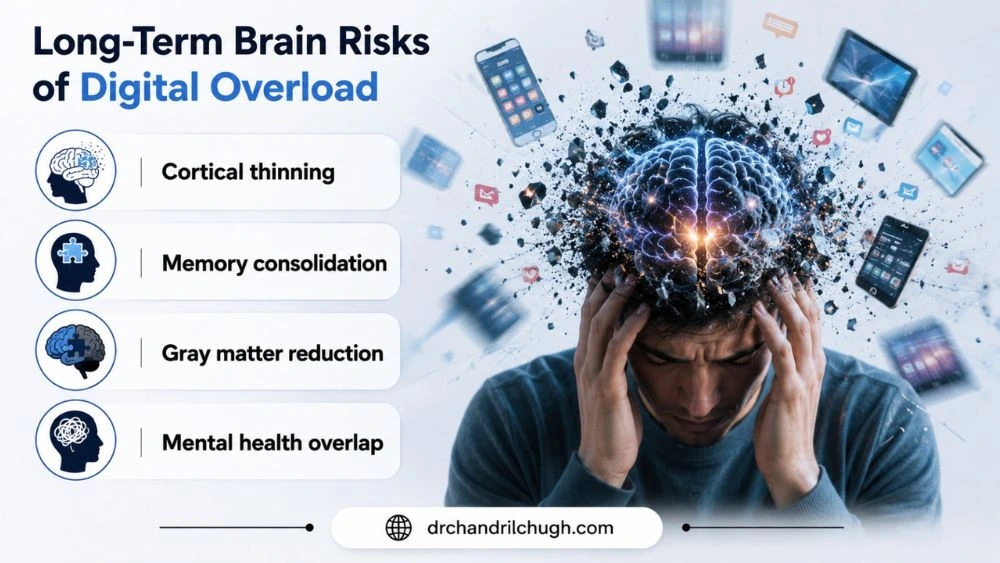
Digital overload & brain function research now identifies risks beyond temporary fatigue.
- Cortical thinning: The NIH Adolescent Brain Cognitive Development (ABCD) study in 2018 found measurable cortex thinning in children with 7+ daily screen hours compared to those under 1 hour.
- Memory consolidation failure: Sleep disruption from screen use prevents memories from transferring to long-term storage. The hippocampus requires deep sleep to complete this process.
- Gray matter reduction: A 2012 study in PLOS ONE found reduced gray matter density in impulse-control regions of heavy internet users.
- Mental health overlap: A 2019 meta-analysis in Preventive Medicine Reports linked social media use exceeding 3 hours daily to clinical anxiety and depression symptoms across 13 independent studies.
Screen Time Management Techniques
Screen time management techniques that produce results don’t rely on willpower. They restructure the environment so the brain isn’t fighting constant temptation.
The 20-20-20 Rule
Every 20 minutes of screen use, look at something 20 feet away for 20 seconds. This rests the visual cortex and reduces eye strain. The American Academy of Ophthalmology endorses this as a standard intervention for digital eye fatigue.
Notification Batching
Check notifications in 3 fixed windows per day, such as 9 AM, 1 PM, and 5 PM. Real-time checking spikes dopamine and cortisol repeatedly. Batching eliminates those spikes and reduces compulsive phone-checking behavior within 2 weeks.
Grayscale Mode
Switching your phone display to grayscale removes the color-based visual rewards that make apps compelling. Research from the Digital Wellness Lab shows grayscale mode reduces average daily phone use by 37 minutes with no extra effort required.
Pre-Sleep Screen Cutoff
Set a strict 60-minute no-screen window before bed. This allows melatonin to rise naturally. If screens before bed are unavoidable, blue light blocking glasses filtering wavelengths below 550nm reduce melatonin suppression by approximately 58%, per a 2021 study in Chronobiology International .
Restoring Brain Function After Digital Fatigue
Digital overload & brain function recovery is real. The brain reorganizes given the right conditions.
Sleep as the Primary Reset
Seven to nine hours of uninterrupted sleep is the most effective brain recovery tool available. No supplement replaces it. During stage 3 NREM sleep, the glymphatic system activates, clearing waste and restoring synaptic efficiency.
Exercise Raises BDNF
Brain-Derived Neurotrophic Factor (BDNF) supports neuron repair and growth. Thirty minutes of moderate aerobic exercise raises BDNF within a single session. A 2016 study in Neuroscience confirmed that even a 10-minute walk after sustained cognitive work improved hippocampal function in the same session.
Nature Exposure Lowers Cortisol
A 2019 study in Frontiers in Psychology found that 20 minutes in a natural setting, just sitting near trees, measurably reduced cortisol levels in urban adults. For city dwellers, even viewing greenery through a window had partial cortisol-lowering effects.
Monotasking Rebuilds Attention Capacity
Spending extended time on a single task without switching rebuilds the attention system that digital overload degrades. Start with 15-minute single-task blocks and increase by 5 minutes each week. Sustained attention capacity typically restores within 3 to 4 weeks.
Lifestyle Habits That Protect Brain Health in a Digital World
Digital overload & brain function decline is largely preventable with consistent daily habits.
- Omega-3 DHA: Supports neuronal membrane health and reduces neuroinflammation from cognitive fatigue. Found in fatty fish and algae-based supplements.
- Magnesium glycinate: Crosses the blood-brain barrier and supports slow-wave sleep. A 300-400 mg dose before bed improves stage 3 NREM sleep quality, per a 2012 study in the Journal of Research in Medical Sciences .
- Face-to-face interaction: In-person conversation activates social brain circuits differently than digital interaction, and it protects against cognitive decline. The Harvard Study of Adult Development identifies strong social relationships as the strongest predictor of cognitive longevity.
- MBSR meditation: Eight weeks of Mindfulness-Based Stress Reduction practice increases gray matter density in the prefrontal cortex and hippocampus, per Harvard neuroscientist Sara Lazar’s 2011 research.
FAQs
What is digital overload and how does it affect the brain?
Digital overload & brain function decline occurs when screen exposure exceeds the brain’s processing capacity across sustained periods. It triggers dopamine desensitization, cortisol elevation, and prefrontal cortex fatigue. Adults at 11+ daily screen hours show measurable attention and working memory deficits within weeks.
Can too much screen time cause brain fog?
Yes. Brain fog from too much screen time results from glucose depletion after prolonged visual and cognitive processing. Four or more consecutive screen hours without breaks consistently produces measurable cognitive slowing, worsened by poor sleep from evening blue light exposure.
How does blue light affect sleep and brain function?
Blue light and circadian rhythm disruption occurs because 450nm light suppresses melatonin by up to 85%. Two hours of evening phone use delays sleep onset by 1.5 hours. Reduced deep sleep stops the brain from clearing amyloid-beta, a protein directly linked to Alzheimer’s progression.
Does multitasking reduce brain performance?
Yes. The brain cannot run two cognitive tasks simultaneously. Task-switching raises error rates by 40% and depletes cognitive resources faster than single-task work, per American Psychological Association research. Every switch carries a measurable performance cost.
What are the long-term effects of excessive screen time?
Digital overload & brain function research confirms cortical thinning in children with 7+ daily screen hours (NIH ABCD study, 2018), gray matter reduction in impulse-control regions, memory consolidation failure from disrupted sleep, and clinical anxiety rates that climb sharply after 3 daily hours of social media.
Can digital overload lead to memory problems?
Yes. Cortisol from chronic screen stress damages hippocampal neurons directly. Disrupted sleep blocks memory transfer from short-term to long-term storage. Both effects compound over months, producing retrieval deficits that show up as forgetting recent conversations and tasks.
How can I reduce screen time effectively?
Screen time management techniques with the strongest evidence are notification batching (3 fixed windows daily), phone grayscale mode (reduces use by 37 minutes on average), and a 60-minute pre-sleep screen cutoff. These outperform willpower-based limits because they restructure the environment.
Does taking breaks improve brain function?
Yes. The 20-20-20 rule reduces visual cortex fatigue. A 10-minute walk after 90 minutes of screen work raises BDNF and improves hippocampal performance within the same session, based on 2016 Neuroscience research.
Can brain function recover after digital fatigue?
Yes. Digital fatigue and brain performance recovery is fastest with 7-9 hours of sleep, 30 minutes of aerobic exercise, and 20 minutes of nature exposure daily. Measurable cognitive improvements appear within 2 weeks of applying all three consistently.
When should I worry about screen-related cognitive issues?
Seek neurological evaluation when brain fog, memory gaps, or attention problems persist after 2 full weeks of reduced screen use and improved sleep. Symptoms lasting beyond that window, especially with mood changes or daily functioning difficulties, warrant professional assessment.
About The Author

Medically reviewed by Dr. Chandril Chugh, MD, DM (Neurology)
Dr. Chandril Chugh is a U.S.-trained, board-certified neurologist with expertise in diagnosing and managing neurological disorders, including migraines, epilepsy, Parkinson’s disease, and movement disorders. His clinical focus includes evidence-based neurological care and patient education.
All content is reviewed for medical accuracy and aligned with current neurological guidelines.