Ocular migraines cause temporary visual disturbances, including flashing lights, zigzag lines, and brief vision loss, usually in one eye. Most episodes last 5 to 60 minutes and resolve on their own without permanent damage. They are neurological events, not eye diseases.
This condition is often confused with stroke, retinal detachment, and migraine with aura. That confusion leads to panic, wrong treatment, and missed warning signs.
Key Takeaways
- Ocular migraines cause visual symptoms like blind spots, zigzag lines, and temporary vision loss, lasting 5 to 60 minutes.
- Temporary vision loss from ocular migraine episodes affect one eye and resolve fully within an hour.
- Screen time and ocular migraines are connected through blue light sensitivity and digital eye strain.
- How to treat ocular migraines depends on frequency: rest for rare attacks, preventive medications for frequent ones.
- Ocular migraines are not the same as migraine with aura. The mechanism, eye involvement, and risk profile differ significantly.
Ocular Migraines Symptoms
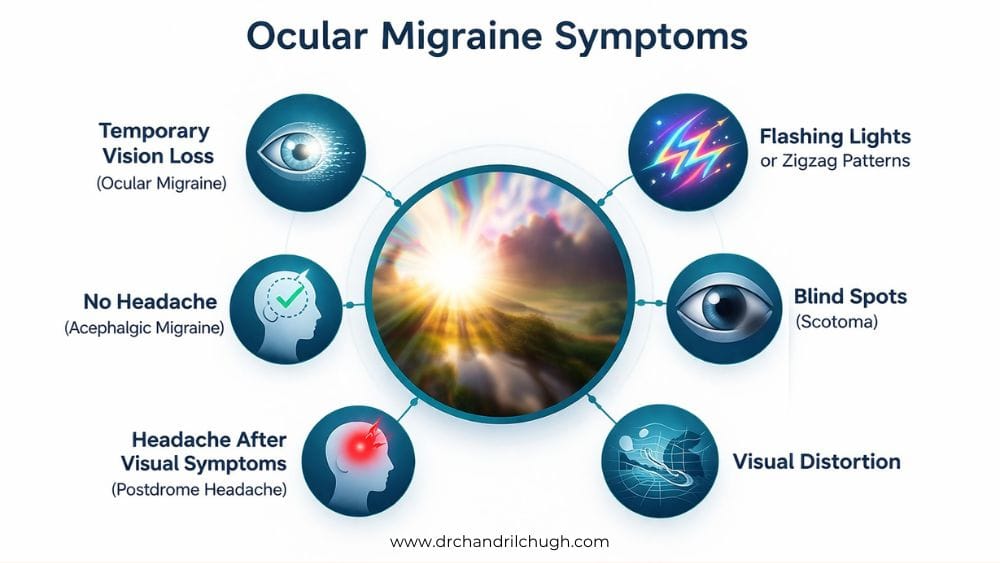
Ocular migraines symptoms appear suddenly and affect vision. They are brief, predictable, and follow a recognizable pattern once you know what to look for.
Temporary Vision Loss Ocular Migraine
Temporary vision loss from ocular migraine affects one eye at a time. Vision dims, blurs, or goes completely dark in that eye for 5 to 30 minutes. It returns fully without treatment. This one-eye distinction separates it from migraine with aura, which affects both eyes.
Flashing Lights or Zigzag Patterns
Bright flashing lights, zigzag lines, or shimmering arcs appear in the visual field. These are called scintillating scotomas. They grow from a small spot and spread outward over 20 to 30 minutes.
Blind Spots (Scotoma)
A dark or grey patch blocks part of the vision. This blind spot grows slowly and then fades. It does not cause pain on its own.
Visual Distortion
Objects appear wavy, fractured, or warped. Straight lines bend. Text becomes hard to read. This distortion lasts the duration of the episode and clears completely afterward.
Headache After Visual Symptoms
Some people get a throbbing headache after the visual symptoms end. The headache typically starts within 60 minutes of the visual episode finishing.
No Headache (Acephalgic Migraine)
Around 40% of people with ocular migraines never get a headache. The visual symptoms happen alone. This is called an acephalgic or silent migraine. Many people in this group go undiagnosed for years because they do not connect the visual episode to migraines.
Duration: Visual symptoms last 5 to 60 minutes. Episodes that last longer than 60 minutes need immediate medical evaluation.
Causes of Ocular Migraines
Causes of ocular migraines are split into two categories: brain-based and retinal. Knowing the difference changes both the risk level and the treatment approach.
Cortical Spreading Depression
The brain-based cause involves a wave of electrical activity that moves across the visual cortex at the back of the brain. This wave temporarily disrupts normal brain function. It produces the zigzag lines and visual disturbances. This mechanism matches the one that causes classic migraines with aura.
Retinal Blood Flow Changes
The retinal type involves a brief spasm or narrowing of blood vessels inside the retina of one eye. This reduces blood flow to part of the retina and causes a temporary vision loss ocular migraine episode. This type carries a slightly higher risk and needs closer monitoring.
Trigeminal Nerve Activation
The trigeminal nerve sends pain signals across the face and head. When it activates during a migraine event, it releases chemicals that inflame blood vessels. This affects both head pain and blood flow to the eye area.
Hormonal Fluctuations
Estrogen drops before menstruation lower serotonin stability. This makes blood vessels in the brain and retina more reactive. Women experience ocular migraines at three times the rate of men, primarily because of this hormonal pattern.
Stress Triggers
Stress raises cortisol. Cortisol destabilizes serotonin and increases blood vessel reactivity. Many people report their first ocular migraine episode happening during or right after a high-stress period.
Ocular Migraine vs Migraine With Aura
Ocular migraines and migraine with aura share visual symptoms, but the mechanism, affected eye, risk level, and treatment differ.
One Eye vs Both Eyes
Ocular migraines affect one eye only. Cover the unaffected eye and the symptoms remain. Migraine with aura affects both eyes because the disturbance happens in the brain’s visual cortex, which processes vision from both eyes simultaneously.
Brain-Based vs Retinal Mechanism
Migraine with aura originates in the brain. Ocular migraines (the retinal type) originate inside the eye itself. This distinction matters because retinal events carry a small but real risk of retinal artery occlusion, a more serious vascular event.
Duration Differences
Migraine with aura visual symptoms last 20 to 60 minutes. Retinal ocular migraines can be shorter, sometimes as brief as 5 minutes.
Stroke Mimic Risk
Both conditions can look like a TIA (mini-stroke) to someone who does not know what is happening. The key difference: stroke visual symptoms do not follow the classic spreading zigzag pattern. Stroke vision loss is sudden and stays lost. Migraine vision loss grows slowly and returns fully.
| Feature | Ocular Migraine | Migraine With Aura | Stroke |
| Eye involvement | One eye | Both eyes | One side of visual field |
| Pattern | Zigzag, spreading | Zigzag, spreading | Sudden, no pattern |
| Duration | 5 to 60 minutes | 20 to 60 minutes | Does not resolve |
| Recovery | Full, always | Full, always | Partial or none |
| Headache after | Sometimes | Usually | No |
| Emergency risk | Low to moderate | Low | High |
Screen Time and Ocular Migraines
Screen time and ocular migraines are connected. Screens do not cause ocular migraines directly, but they lower the threshold for attacks in people already prone to them.
Blue Light Sensitivity
Blue light from phones, tablets, and monitors activates photoreceptors in the retina more intensely than other light wavelengths. In migraine-prone individuals, this overstimulation pushes the brain toward triggering a visual episode.
Flicker Sensitivity
Most screens refresh 60 times per second. This invisible flicker is undetectable to most people, but migraine-sensitive brains pick it up and respond with cortical spreading depression. Higher refresh rate monitors (120Hz or above) reduce this risk significantly.
Digital Eye Strain
Prolonged focus on screens reduces blink rate from 15 times per minute to about 5 times per minute. This dries out the eye surface, increases strain on the eye muscles, and creates the eye fatigue that frequently precedes a screen time and ocular migraine episode.
Prolonged Near Work
Reading, coding, and detailed close work for extended periods contract the ciliary muscles inside the eye. Sustained muscle tension in and around the eye contributes to migraine triggering in susceptible people.
Preventive Screen Adjustments
- Use screens at 50 to 70% brightness, not maximum.
- Enable night mode or warm color temperature settings after 6 PM.
- Follow the 20-20-20 rule: every 20 minutes, look at something 20 feet away for 20 seconds.
- Choose monitors with 120Hz or higher refresh rates.
- Use anti-glare screen filters in bright environments.
How Ocular Migraines Are Diagnosed
Clinical History
Diagnosis is primarily based on symptom history. The doctor asks about episode duration, which eye is affected, whether headache follows, and how often attacks occur. A clear pattern of one-eye involvement with full recovery strongly suggests ocular migraines.
Eye Examination
An eye doctor examines the retina during or shortly after an episode to check for signs of retinal artery spasm or ischemia. In most cases, the exam looks normal between attacks because the episode fully resolves.
When Imaging Is Needed
Brain MRI is ordered when visual symptoms last longer than 60 minutes, occur in both eyes, or appear for the first time in someone over 40 with no prior migraine history.
Ruling Out Retinal Detachment
Retinal detachment also causes sudden vision changes, but it produces floaters and a curtain-like shadow moving across the visual field. It does not follow the zigzag spreading pattern of ocular migraines and does not resolve on its own.
Ruling Out TIA
A TIA (transient ischemic attack) causes vision loss without the classic zigzag spreading aura. TIA vision loss is abrupt and affects the same side of vision in both eyes. Any first-episode visual loss in someone over 50 needs urgent evaluation to rule this out.
How to Treat Ocular Migraines
How to treat ocular migraines depends on how often they happen and how disabling they are.
Immediate Rest in Dark Room
Stop all activity when an episode starts. Sit or lie down in a dark, quiet room. Avoid screens immediately. Most episodes resolve within 30 minutes with rest alone.
Acute Migraine Medications
- Ibuprofen or aspirin taken at the first sign of an episode reduces associated headache.
- Triptans (sumatriptan) work for people whose visual episodes consistently lead to moderate-to-severe headaches.
- Triptans are not recommended during the visual phase itself. Take them when the headache begins.
Preventive Therapy
For people with more than 2 episodes per month, doctors prescribe:
- Propranolol (beta blocker) taken daily
- Amitriptyline (low-dose, stabilizes serotonin)
- Topiramate (reduces cortical excitability)
- Verapamil (calcium channel blocker used specifically for retinal-type ocular migraines )
Magnesium Supplementation
Magnesium deficiency raises cortical excitability and increases migraine frequency. Research published in the journal Headache found 600mg of magnesium glycinate daily reduced migraine frequency by 41% over 12 weeks. This works for ocular migraines as well as classic migraines.
Trigger Avoidance
- Cut tyramine-rich foods: aged cheese, red wine, cured meats.
- Stop or reduce caffeine if consumption is above 2 cups per day.
- Keep meal timing consistent. Skipping meals drops blood sugar and triggers attacks.
Preventing Ocular Migraines
Sleep Regulation
Sleep under 7 hours raises CGRP blood levels measurably. Keep wake and sleep times consistent, even on weekends. Irregular sleep schedules are one of the most consistent triggers for ocular migraines in adults.
Stress Reduction
Cognitive behavioral therapy (CBT) reduces migraine frequency by 30 to 40% in stress-triggered cases. Even 10 minutes of daily diaphragmatic breathing lowers cortisol enough to reduce attack frequency over 4 to 6 weeks.
Hormonal Pattern Monitoring
Track visual episodes alongside menstrual cycles. Women who see attacks cluster in the 2 days before their period starts benefit from preventive medication timed around their cycle.
Screen Time Limitation
Cap continuous screen use at 90 minutes. Take breaks. Reduce total daily screen time if episodes increase during high-screen-use periods.
Food Trigger Tracking
Keep a daily food and symptom log for 4 weeks. Patterns emerge within that window. Common migraine food triggers include red wine, chocolate, MSG, artificial sweeteners, and citrus fruits in excess.
When Ocular Migraine Is a Medical Emergency
Vision Loss Lasting More Than 1 Hour
Temporary vision loss from ocular migraine resolves within 60 minutes. Loss of vision beyond that window is not a standard migraine. It requires emergency evaluation for retinal artery occlusion or stroke.
New Weakness or Numbness
Any episode of visual disturbance combined with arm weakness, facial numbness, or difficulty walking is a stroke until proven otherwise. Call emergency services immediately.
Slurred Speech
Slurred or confused speech alongside visual symptoms is a stroke symptom. Do not wait to see if it passes.
First Episode After Age 40
A first-ever visual episode in someone over 40 with no prior migraine history needs same-day evaluation. The risk of vascular causes is significantly higher in this group.
Sudden Severe Headache
A headache described as the worst of your life, starting suddenly alongside visual symptoms, can signal a subarachnoid hemorrhage. This is a life-threatening emergency.
FAQs
How long does temporary vision loss last in ocular migraine?
Temporary vision loss ocular migraine episodes last 5 to 30 minutes in most cases. The ICHD-3 diagnostic criteria set 60 minutes as the upper boundary. Vision after an episode returns to 100% baseline. Any loss extending beyond 60 minutes requires emergency evaluation for retinal artery occlusion.
Are ocular migraines dangerous?
No, in most cases. Standard ocular migraines with full visual recovery within 60 minutes carry no lasting damage risk. The retinal type, however, carries a small risk of permanent vision loss if blood flow to the retina is disrupted repeatedly. Frequent retinal episodes need a neurologist and ophthalmologist working together.
How do you treat ocular migraines?
Rest in a dark room stops most mild episodes within 30 minutes. For episodes linked to moderate headache, ibuprofen or sumatriptan taken when the headache phase begins reduces severity. For more than 2 attacks per month, doctors prescribe daily propranolol, amitriptyline, or topiramate as preventive treatment for ocular migraines.
Can screen time trigger ocular migraines?
Yes. Screen time and ocular migraines are linked through blue light overexposure, screen flicker, and digital eye strain. Screens do not cause the condition independently. They lower the attack threshold in people already prone to ocular migraines. Limiting sessions to 90 minutes with breaks and switching to 120Hz monitors reduces this risk.
Is ocular migraine the same as migraine with aura?
No. Ocular migraines affect one eye and originate in the retina. Migraine with aura affects both eyes and originates in the brain’s visual cortex. Both produce zigzag patterns and blind spots, but the one-eye test separates them. Cover the unaffected eye during an episode. If symptoms remain, it is retinal. If they disappear, it is cortical.
Can ocular migraines cause permanent vision loss?
Rarely, but yes. Repeated retinal-type ocular migraines can cause permanent blind spots if retinal artery spasms are severe or prolonged. This affects fewer than 1 in 100 cases. The cortical type, which is far more common, does not cause permanent vision loss.
Should I see an eye doctor for ocular migraine?
Yes, for your first episode. An ophthalmologist rules out retinal detachment, glaucoma, and retinal artery occlusion. After confirmation of ocular migraines, a neurologist manages ongoing treatment. Both specialties are needed for retinal-type cases.
How often can ocular migraines occur?
Frequency varies widely. Some people have one episode in their lifetime. Others have 2 to 4 per month. Frequency above 2 per month qualifies as chronic and warrants daily preventive medication. Tracking triggers like sleep, food, and stress often reveals controllable patterns that reduce attack frequency significantly.
Are ocular migraines related to stress?
Yes. Stress raises cortisol, which disrupts serotonin and increases blood vessel reactivity in the brain and retina. Many people report their first or worst ocular migraine episodes during exam periods, work deadlines, or family crises. CBT reduces stress-triggered attack frequency by 30 to 40% within 8 to 12 weeks.
Can dehydration trigger ocular migraines?
Yes. Dehydration raises blood CGRP levels and reduces the brain’s pain threshold. Even mild dehydration of 1 to 2% body weight triggers ocular migraines in susceptible people. Drinking 2 to 2.5 liters of water daily is a consistent preventive measure supported by migraine research.
About The Author

Medically reviewed by Dr. Chandril Chugh, MD, DM (Neurology)
Dr. Chandril Chugh is a U.S.-trained, board-certified neurologist with expertise in diagnosing and managing neurological disorders, including migraines, epilepsy, Parkinson’s disease, and movement disorders. His clinical focus includes evidence-based neurological care and patient education.
All content is reviewed for medical accuracy and aligned with current neurological guidelines.