The best mattress for ankylosing spondylitis is a medium-firm to firm hybrid that keeps the spine neutral, relieves pressure points, and does not trap heat. Ankylosing spondylitis (AS) is an autoimmune condition where chronic inflammation targets the spine and sacroiliac joints (the joints connecting the lower spine to the pelvis), causing progressive stiffness and pain that intensifies at night and in early morning.
You wake up stiffer than when you went to bed. The mattress is a direct contributor to that. Choosing the right mattress is a medical decision as much as a comfort one.
Key Takeaways
- The best mattress for ankylosing spondylitis maintains neutral spinal alignment and reduces pressure on inflamed joints.
- Medium-firm to firm support is the standard recommendation for AS-related spinal stiffness.
- A hybrid mattress for autoimmune back pain combines coil support with foam contouring for the right balance.
- A cooling mattress for ankylosing spondylitis night pain helps because inflammation raises local tissue temperature and disrupts sleep.
- Mattress choice directly affects thoracic spine pain severity and morning stiffness duration.
- Soft, sagging mattresses worsen spinal positioning during the long overnight inflammatory window.
10 Best Mattresses for Ankylosing Spondylitis: What Features to Look For
The 10 best mattresses for ankylosing spondylitis are about features. Any mattress that includes these ten characteristics is worth serious consideration.
1. Medium-Firm Hybrid Support
A medium-firm rating (around a 5 to 7 on the firmness scale out of 10) supports the spine without pushing into sensitive joints. This is the single most important feature for AS patients.
2. Zoned Lumbar Reinforcement
Zoned support means different sections of the mattress have different firmness levels. The lumbar zone (lower back) is firmer to prevent sagging under the heaviest part of the body, while the shoulder zone is slightly softer to relieve pressure. For AS, this prevents the lower spine from dipping into misalignment overnight.
3. High-Density Foam Core
Foam density is measured in pounds per cubic foot. High-density foam (4.0 lb/cu ft or above) does not break down quickly under body weight. Lower-density foam develops body impressions within months, destroying the alignment support that AS patients depend on.
4. Cooling Gel Layer
Gel-infused foam layers absorb and disperse body heat rather than trapping it. This is specifically relevant to the cooling mattress for ankylosing spondylitis night pain because AS inflammation raises local tissue temperature, and heat retention worsens both pain perception and sleep quality.
5. Latex Responsiveness
Natural latex (rubber from rubber trees) is responsive, meaning it pushes back against the body rather than letting it sink slowly. This responsiveness maintains spinal alignment through position changes at night. Latex also sleeps cooler than memory foam by default.
6. Adjustable Base Compatibility
An adjustable base allows the head and foot sections to be elevated independently. For AS patients with thoracic or lumbar involvement, slight elevation reduces joint compression. Not every mattress works with an adjustable base. Check for compatibility before purchasing.
7. Motion Isolation for Night Turning
AS patients shift positions frequently due to pain. A mattress with good motion isolation absorbs movement rather than transferring it across the surface. This is particularly useful for people who share a bed and do not want to fully wake a partner during repositioning.
8. Edge Support for Mobility
Reinforced edges prevent the mattress from collapsing when you sit on the side to get up. AS patients often have reduced hip and back mobility. A collapsing edge makes standing from bed harder and more painful.
9. Pressure-Relief Top Layer
A comfort layer of 5 to 7 centimeters of softer foam or latex sits above the support core and cushions the hips, shoulders, and thoracic spine. This layer prevents pressure points from building up over hours on a firm surface.
10. Durable Structural Design
The structural durability of the best mattress for ankylosing spondylitis matters more than for average sleepers. AS patients need consistent support throughout the life of the mattress. Look for at least a 10-year warranty and CertiPUR-US certification on foam components (which confirms the foam meets durability and chemical safety standards).
Why Mattress Choice Matters in Ankylosing Spondylitis
Choosing the best mattress for ankylosing spondylitis is different from choosing a mattress for general back pain. The disease process itself makes sleep surface selection a medical priority.
Inflammatory Back Pain Mechanism
AS triggers the immune system to attack the entheses (the points where tendons and ligaments attach to bone, especially along the spine). This produces inflammatory cytokines (chemical messengers that drive inflammation) that are most active at night and in the early morning. This is why AS pain classically worsens during rest, unlike mechanical back pain that improves with lying down.
Spinal Fusion Risk and Posture Changes
AS can cause the spinal vertebrae to fuse together over years if inflammation is uncontrolled. As fusion progresses, the spine’s natural curves change. A mattress bought years ago may no longer support the current posture accurately, making regular reassessment of mattress fit necessary.
Nocturnal Stiffness and Cytokine Activity
Cytokines (the proteins that drive AS inflammation) peak between midnight and 4am. During this window, joint stiffness is at its worst. A mattress that cannot support the spine through these peak inflammatory hours compounds the damage. Conversely, a well-supported spine reduces the mechanical load on already-inflamed joints during the most vulnerable hours.
Thoracic Spine Pain at Night
AS frequently affects the thoracic spine (mid and upper back), which most general back pain mattress guides completely ignore. Standard mattress advice focuses on the lumbar region. But for AS patients, thoracic joint inflammation means the mid-back needs equal pressure relief. A mattress that is zoned only for lumbar support but firm under the thoracic area increases thoracic joint compression through the night.
Mattress Type Recommended for Spinal Stiffness
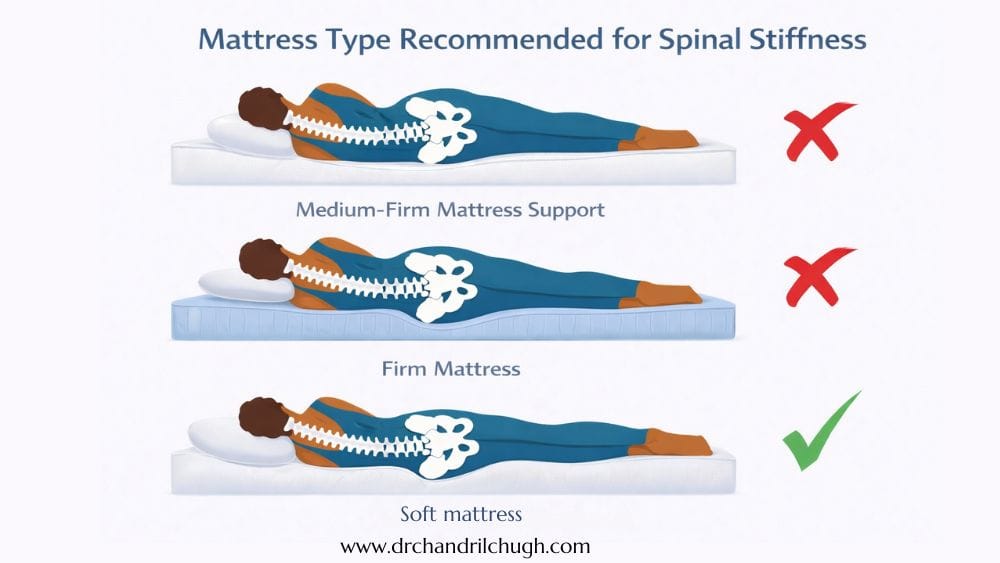
The mattress type recommended for spinal stiffness in AS is not one-size-fits-all, but there is a clear hierarchy based on what the spine needs during an inflammatory disease.
Medium-Firm Mattress Support
Medium-firm is the most broadly effective option. It allows slight contouring at the hips and shoulders while keeping the lumbar and thoracic spine supported above the sag threshold. Clinicians and physical therapists working with AS patients most commonly recommend this firmness range.
Firm Mattress: When It Helps
A truly firm mattress (8 to 9 out of 10) helps AS patients who are heavier (over 90 kg / 200 lbs) because body weight causes medium-firm surfaces to feel softer than their rating. For these patients, a firmer base with a separate pressure-relief topper gives better control over the final feel.
Why Soft Mattresses Worsen Alignment
A soft mattress lets the heaviest body parts (hips and pelvis) sink below the natural spinal curve. This creates a hammock effect, where the lower back rounds downward. For AS patients, this position keeps the already-inflamed sacroiliac joints and lumbar segments compressed in a flexed posture through the entire night, increasing morning stiffness duration.
Zoned Support Systems
Zoned support mattresses use different coil gauges (thickness) or foam densities in specific areas. Firmer in the lumbar zone, medium under the torso, slightly softer at the shoulder zone. This zoning is the closest thing to a spine-specific sleeping surface available without custom manufacturing.
| Mattress Type | Support Level | Best For AS Patients | Risk for AS Patients |
| Soft Foam | Low | Not recommended | Spinal sagging, increased morning stiffness |
| Medium-Firm Hybrid | Moderate-High | Most AS patients | Minimal when fitted correctly |
| Firm Latex | High | Heavier patients, thoracic involvement | Pressure buildup without comfort layer |
| Memory Foam (standard) | Moderate | Side sleepers with mild AS | Heat retention, slow response to movement |
| Zoned Hybrid | High with variation | AS with thoracic and lumbar involvement | Lowest overall risk |
Hybrid Mattress for Autoimmune Back Pain
A hybrid mattress for autoimmune back pain, like AS is the most consistently recommended mattress construction because it solves two problems at once: support and pressure relief.
Coil and Foam Support Combination
Hybrid mattresses combine a pocketed coil (individually wrapped spring) base with foam or latex comfort layers. The coils provide responsive, firm support that holds the spine in alignment. The foam layers above them cushion pressure points without allowing the spine to sink below alignment.
Pressure Relief Without Sagging
A common complaint about pure foam mattresses in AS is that they soften over time and lose their support. Pocketed coils in a hybrid do not compress permanently. They return to their original position after each use, maintaining consistent support over years.
Motion Isolation Benefits
Each pocketed coil moves independently, absorbing movement rather than spreading it. For AS patients who reposition 10 to 20 times per night due to pain, this reduces the number of full awakenings that come from feeling their own repositioning.
Long-Term Structural Stability
Hybrid mattresses with high-density foam layers and tempered steel coils typically maintain their support properties for 7 to 10 years. This is longer than all-foam alternatives and reduces the cost-per-year of adequate spinal support over time.
Cooling Mattress for Ankylosing Spondylitis Night Pain
A cooling mattress for ankylosing spondylitis night pain is a functional need if you have AS.
Heat Sensitivity and Inflammation
AS inflammation directly raises the temperature of affected joints and surrounding soft tissue. Sleeping on a heat-trapping mattress surface adds an external heat source on top of an already elevated local temperature. This compounds discomfort and increases the likelihood of waking during the cytokine activity peak between midnight and 4 am.
Gel-Infused Foam vs Breathable Latex
Gel-infused foam absorbs heat from the body surface and disperses it through the foam structure. It performs better than standard memory foam but still retains some heat over long sleep periods. Breathable latex allows active airflow through its naturally open-cell structure, providing continuous cooling rather than absorbing and re-releasing heat.
Temperature Regulation and Pain Perception
Research on pain physiology consistently shows that elevated skin and tissue temperature lowers the pain threshold (the point at which a sensation registers as painful). Reducing surface temperature even by 1 to 2 degrees Celsius can shift pain perception enough to improve sleep continuity for inflammatory back pain patients.
When Cooling Is Actually Helpful
A cooling mattress for ankylosing spondylitis night pain is especially important for patients who report night sweats, those taking biological medications (such as TNF inhibitors like adalimumab or etanercept, which affect the immune response and can alter body temperature regulation), and those who live in warm climates where room temperature stays above 20 degrees Celsius at night.
Sleeping Positions That Work Best with the Right Mattress
The best mattress for ankylosing spondylitis only works when combined with a position that does not undo its support.
Back Sleeping with Lumbar Support
Back sleeping on a medium-firm hybrid maintains the lumbar curve best. Place a firm pillow under the knees to reduce lumbar arch strain. If the thoracic spine feels unsupported, a thin rolled towel under the upper back fills the gap without over-extending.
Side Sleeping with Knee Pillow
Side sleeping is useful for AS patients with hip flexor tightness. Place a firm pillow between the knees and ankles to keep the pelvis level. Without the pillow, the top leg pulls the pelvis into rotation and stresses the sacroiliac joints through the night.
Avoiding Excessive Fetal Curl
A tight fetal position rounds the thoracic and lumbar spine significantly. Over hours on a mattress, this position compresses the anterior (front) spinal joints and stretches the posterior (back) ligaments. For AS, where anterior spinal involvement is common, this adds mechanical load to already-inflamed tissue.
Adjusting for Morning Stiffness
Before getting up, spend 2 to 3 minutes performing gentle spinal rotations (lying flat and slowly rotating the knees side to side) on the mattress surface. This activates synovial fluid (the lubricating fluid in joints) in the spinal facet joints before you put weight through them. A supportive mattress makes this easier because the surface holds the spine level during the movement.
Common Mattress Mistakes That Worsen Ankylosing Spondylitis
Choosing Too Soft for Comfort
A soft mattress feels better in the first 5 minutes of lying down. But over 7 to 8 hours, it allows the spine to settle into misalignment. Most AS patients who report worsening morning stiffness after buying a new mattress chose one that was too soft.
Ignoring Thoracic Support
The thoracic spine is the section most neglected in general mattress guidance. AS patients need a mattress that supports the full spinal length, not just the lumbar region. A mattress for thoracic spine pain at night needs to keep the mid-back level, which requires zoned support across the entire spine, not just the lower section.
Delaying Mattress Replacement
A mattress with visible sagging of 2.5 centimeters or more in the center no longer provides adequate spinal support for any sleeper. For AS patients, that threshold is effectively lower because even minor misalignment compounds inflammatory joint loading. Replacing a degraded mattress is not a luxury expense for AS patients. It is part of disease management.
Overlooking Pillow Alignment
A good mattress with the wrong pillow still produces neck and thoracic strain. The pillow must fill the gap between the head and the mattress surface accurately. In back sleeping, a medium-loft pillow works. In side sleeping, the pillow should be thick enough to keep the neck level with the spine.
Using Heat-Retaining Surfaces
Standard memory foam mattresses retain significantly more heat than latex or hybrid alternatives. For an AS patient whose joints are already running hot, sleeping on a heat-retaining surface for 8 hours worsens overnight inflammation. Gel-infused or latex top layers are not optional extras for AS. They affect pain outcomes.
FAQs
What is the best mattress for ankylosing spondylitis?
The best mattress for ankylosing spondylitis is a medium-firm zoned hybrid combining pocketed coils with a gel-infused or latex comfort layer. It must support the full spine including the thoracic region, allow position changes without motion transfer, and resist heat retention throughout the night.
Is a firm mattress better for spinal stiffness?
Yes, firm is better than soft, but medium-firm outperforms fully firm for most AS patients. A mattress rated 5 to 7 on the firmness scale supports the spine without creating pressure points at the hips and shoulders that increase pain and encourage position changes.
Are hybrid mattresses good for autoimmune back pain?
Yes. A hybrid mattress for autoimmune back pain is the top-recommended construction for AS. Pocketed coils maintain long-term support without sagging, and the foam or latex comfort layer addresses pressure points without letting the spine sink below alignment level.
Does a cooling mattress help ankylosing spondylitis night pain?
Yes. A cooling mattress for ankylosing spondylitis night pain reduces external heat load on already-inflamed joints. Inflammatory tissue runs hotter than normal. Gel-infused foam reduces skin surface temperature by 1 to 2 degrees Celsius compared to standard memory foam, which measurably improves pain threshold and sleep continuity.
Can a soft mattress worsen ankylosing spondylitis symptoms?
Yes. A soft mattress lets the pelvis and lumbar spine sink into a flexed position. This compresses the sacroiliac joints and anterior spinal segments across the entire sleep period. AS patients on soft mattresses consistently report longer morning stiffness duration and higher pain scores after waking.
What mattress type is recommended for spinal stiffness?
The mattress type recommended for spinal stiffness in AS is a medium-firm hybrid with zoned lumbar reinforcement. Zoned systems provide firmer support under the lumbar and thoracic spine while allowing slight contouring at the shoulder and hip zones, reducing the mechanical load on inflamed joints overnight.
Is memory foam good for ankylosing spondylitis?
Memory foam works for mild AS if it is high-density (4.0 lb/cu ft or above) and gel-infused. Standard memory foam traps heat and responds slowly to movement, which is problematic for AS patients who reposition frequently. A latex or hybrid alternative performs better across most AS cases.
Why does thoracic spine pain worsen at night?
AS inflammation cytokines peak between midnight and 4am. During this window, the thoracic facet joints and costovertebral joints (where the ribs attach to the spine) become most inflamed and stiff. A mattress for thoracic spine pain at night with zoned support under the mid-back keeps these joints from compressing further under body weight.
How often should I replace my mattress with AS?
Replace your mattress every 7 years as a baseline. Inspect every 12 months for visible sagging or body impressions deeper than 2 centimeters. Any sagging beyond that threshold degrades spinal support enough to increase AS-related morning stiffness, regardless of how new the mattress is.
Can the wrong mattress increase morning stiffness?
Yes. The best mattress for ankylosing spondylitis directly reduces morning stiffness duration. A soft or degraded mattress allows the spine to hold a misaligned position through the overnight cytokine activity peak, maximizing joint compression when inflammation is already at its worst. This is why AS patients on poor mattresses regularly report stiffness lasting 2 or more hours after waking.
About The Author

Medically reviewed by Dr. Chandril Chugh, MD, DM (Neurology)
Dr. Chandril Chugh is a U.S.-trained, board-certified neurologist with expertise in diagnosing and managing neurological disorders, including migraines, epilepsy, Parkinson’s disease, and movement disorders. His clinical focus includes evidence-based neurological care and patient education.
All content is reviewed for medical accuracy and aligned with current neurological guidelines.