Pressure points for anxiety are small spots on your skin that respond strongly to firm touch. When you press them in a steady way, signals travel through your nerves to the brain and can help your body shift from high alert into a calmer state.
Studies from hospitals and clinics suggest that using pressure points for anxiety can lower short-term anxiety scores, but results are mixed, and long-term effects are still unclear. Reviews of acupressure points for anxiety relief call the results promising yet limited, so experts treat acupressure as extra support, not as a cure on its own.
Research groups still ask for stronger trials and clear safety data. For you, that means pressure points for anxiety should sit beside therapy, breathing work, exercise, and, when needed, medicine prescribed by a doctor. Guidelines can change as new research appears, so regular check-ins with a health professional stay important.
Acupressure Points For Anxiety Relief
When you press acupressure points for anxiety relief , touch receptors send messages along nerves to the spinal cord and brain. This can lower the activity of the fight-or-flight system, although the best routine and exact mix of points are still not known, and different pressure points for anxiety may suit different people.
Clinical trials show short-term anxiety drops in some groups, but they use different methods and follow people only for a limited time.
A simple home plan starts with a small set of pressure points for anxiety that most people can reach easily. These points on your forehead, ears, shoulders, hands, and feet, and later you can add neck pressure points for anxiety and other anxiety pressure points on body areas such as the chest or upper back if your doctor agrees; with practice, these pressure points for anxiety become quicker to find and use.
Hall Of Impression Point: Calming Head Tension
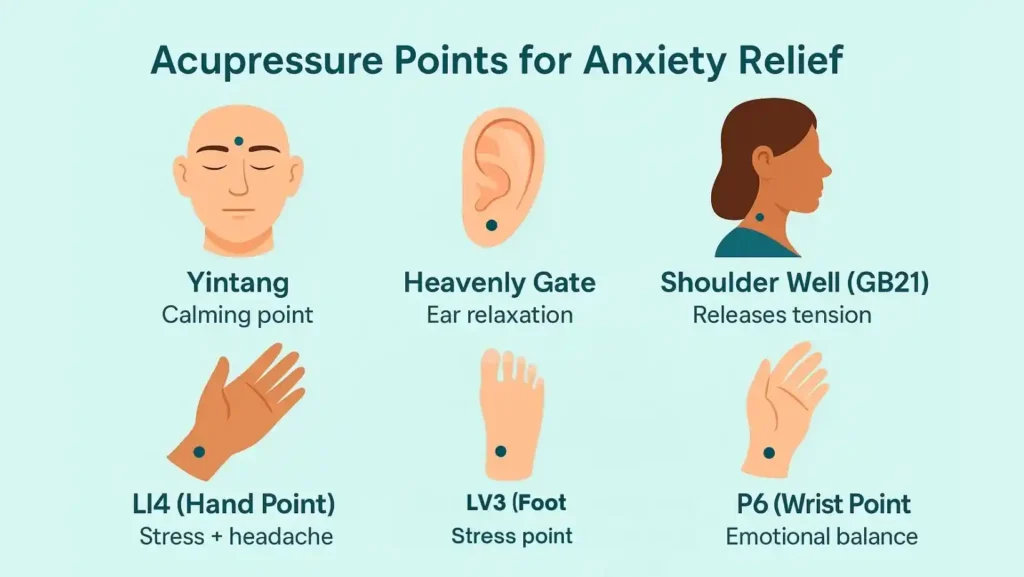
The Hall of Impression point, called Yintang, lies between your eyebrows in the middle of your forehead. It is one of the classic pressure points for anxiety because people often feel this spot tighten when they worry or frown, and many people choose this as their first pressure points for anxiety spot each day.
To use it, place one clean finger between your eyebrows and press gently toward the bone while you close your eyes and breathe slowly. You can hold for ten slow breaths and then notice whether your forehead and eyes feel less tense; many people add this to their daily pressure points for anxiety routine.
Heavenly Gate Point: Ear Based Soothing Point
The Heavenly Gate point is on the upper ear, in a small hollow where the outer rim meets the inner cartilage. Many acupressure charts list it among helpful pressure points for anxiety because it links to brain areas that help control stress and sleep.
Hold your ear between your thumb and index finger and press into the hollow with steady but comfortable pressure while you breathe slowly for thirty to sixty seconds. Change sides and stop if you notice pain, burning, or any skin problem in the area, then ask a health professional before you continue with ear-based pressure points for anxiety .
Shoulder Well Point: Tension Release Spot
The Shoulder Well point lies at the top of your shoulder, halfway between the base of your neck and the outer tip of the bone. It is one of the most practical pressure points for anxiety because stress often makes this band of muscle feel hard and sore.
Reach across your chest with your opposite hand and pinch the top of the shoulder muscle between your thumb and fingers. Hold a deep, dull pressure for about ten slow breaths, then switch sides, stopping at once if you feel sharp pain, tingling, or dizziness, and asking a doctor for advice if that happens more than once.
Union Valley Point: Hand Pressure Point For Anxiety
The Union Valley point, or LI4, sits in the fleshy web between your thumb and index finger. It is one of the best-known hand pressure points for anxiety and headaches, and you can use it quietly almost anywhere.
Open one hand, place the thumb and index finger of your other hand around the web, and squeeze until the area feels achy but not sharp. Because LI4 has been linked with labor in traditional teaching, pregnant people are usually advised to avoid strong or repeated pressure on this point unless a trained provider gives clear approval.
Great Surge Point: Powerful Foot Point For Stress
The Great Surge point, called Liver 3, lies on the top of your foot. Slide a finger up between your big toe and second toe until you feel a tender spot where the bones meet, which is one of the key foot pressure points for anxiety .
Sit in a chair, rest one ankle on the other knee, and press down on this spot with your thumb while you breathe slowly for one to two minutes. If you feel numbness, sharp pain, or cramping, ease the pressure and wait before trying again, and talk with a health professional if problems continue around this or other foot pressure points for anxiety .
Inner Frontier Gate Point: Wrist Point For Emotional Balance
The Inner Frontier Gate point, called P6 or Neiguan, lies on the inner side of your forearm, about three finger widths above the wrist crease in line with the middle of your wrist. It is one of the most researched pressure points for anxiety and also plays a role in nausea care.
Press this spot with your thumb while your fingers support the back of your forearm, and hold firm, even pressure for one to two minutes as you breathe in for four counts and out for six counts.
Hand Pressure Points For Anxiety
Your hands hold several easy-to-reach spots that connect straight to your nervous system. Using hand pressure points for anxiety lets you act fast when your thoughts start to race, even in public settings.
Thumb Web Point For Anxiety Calming
The thumb web on the palm side sits between the base of your thumb and index finger. This spot carries many touch nerves, so it reacts fast when you press it. It is one of the easier hand pressure points for anxiety because you can use it with your hand under a desk or table.
Open your hand and relax your fingers. Place the thumb of your other hand into the soft pad at the base of the thumb. Press toward the index finger bone until you feel a deep, dull ache, not sharp pain. Hold for ten slow breaths while you keep your jaw loose and shoulders down. You can repeat this on the other hand.
You can pair this spot with other pressure points for anxiety, such as the Hall of Impression or Inner Frontier Gate. The mix of hand and head input can help your nervous system read the situation as safer, although research on the thumb web itself is still limited.
Wrist Crease Pressure Method
Across your wrist, you see one or more skin lines called wrist creases. Under these creases lie small nerves and blood vessels that talk to your heart and brain. Working along this line gives you a simple way to reach several hand pressure points for anxiety in a short time.
Turn your palm up. Place the thumb of your other hand on the center of the main crease, just below the base of your palm. Press gently toward your forearm bone and hold for five breaths. Then move your thumb a little toward the thumb side and repeat, then toward the little finger side and repeat. You sweep the whole crease in this way.
You can use it with other pressure points for anxiety when you sit in a waiting room or on public transport. If you have any nerve problem in the hand, ask your doctor first.
Palm Center Tension-Relief Point
The center of the palm is another strong spot among hand pressure points for anxiety . It lies where the tip of your middle finger rests when you curl your fingers softly toward your palm.
Press this point with your thumb and push straight toward the bones of your hand. Hold for ten slow breaths, or up to one minute if it feels comfortable. You can make tiny circles without sliding on the skin. Some people feel warmth spreading from the center of the palm into the fingers.
You can combine the palm center with the thumb web and Union Valley to create a shorthand-only set of pressure points for anxiety that you can use during a busy day. Evidence for specific hand spots is still limited, yet safety is high when you avoid bruised or injured areas.
Foot Pressure Points For Anxiety
Your feet hold many nerve endings. When you work on foot pressure points for anxiety , you bring your focus down from your head into your lower body. This alone can help you feel more grounded and less caught in racing thoughts.
Big Toe Base Relaxation Point
The joint where your big toe meets your foot is often stiff when you feel tense. This joint area can act as one of your foot pressure points for anxiety .
Sit in a chair and rest one ankle on the opposite knee. Hold the big toe near its base between your thumb and index finger. Press gently into the joint from both sides, then hold steady pressure for ten slow breaths. Repeat on the other foot.
This can ease some of the restlessness that shows as foot tapping or toe clenching. You can use it with other pressure points for anxiety when you wind down at night.
Foot Arch Pressure Zone
The inner arch runs from the ball of your foot to the heel. Many people feel stress here as sore or tight spots. The full arch acts like a long band of foot pressure points for anxiety rather than a single dot.
Use both thumbs to press along the curve of the arch, starting near the ball and moving slowly toward the heel. At each sore spot, pause and hold for a few breaths before moving on. Keep pressure firm but still comfortable.
As blood flow improves in the arch, your feet warm and muscles relax. That change in body state can support the mental relief you want from pressure points for anxiety . If you have diabetes with nerve damage, ask your doctor before doing strong footwork.
Ankles And Deep-Calming Point
Above the inner ankle bone, there is a well-known spot that many people treat as one of the deeper foot pressure points for anxiety . It sits a few finger widths above the bony bump, just behind the shin bone.
Place your thumb in this spot and press toward the center of your leg. Hold while you take slow breaths for up to one minute, then repeat on the other leg. Many people feel a sense of heaviness in the legs that can make them feel more settled.
Pregnant people should not use strong pressure near this area without clear guidance from a doctor or midwife because some ankle points are linked with labor in traditional teaching. In that case, use other pressure points for anxiety instead.
Neck Pressure Points For Anxiety
Your neck reacts quickly to stress. Muscles tighten, and you may feel a stiff or heavy head. Working on neck pressure points for anxiety must always stay gentle because important blood vessels and nerves live here.
Neck Base Tension Release
At the base of your skull, on each side of the spine, lies a small hollow in the muscle. These hollows act as helpful neck pressure points for anxiety when used with care.
Place your thumbs in the hollows while your fingers rest on the top of your head for support. Press gently upward toward the skull bone and hold for five to ten breaths. Avoid pressing on the spine itself.
Many people feel a spreading ease in the back of the head and upper neck. This can support the overall effect of other pressure points for anxiety you use on the same day.
Shoulder-Neck Junction Pressure
Where your neck meets the top of your shoulders, the muscles often feel like hard ropes. These spots also belong to your group of neck pressure points for anxiety .
Use your right hand to grab the left shoulder muscle near the neck. Press into the thick part of the muscle with your fingers and thumb, then hold while you breathe slowly. Then change sides. Stop if you feel tingling down the arm or sudden sharp pain.
Side-Neck Stress Relief Point
On the side of your neck, behind the large front neck muscle, there is a soft groove. Gentle touch here works best.
Place two or three fingertips in the groove about halfway between your ear and shoulder. Press very lightly toward the spine and slowly turn your head left and right. This gentle move can ease stiff breathing linked with anxiety and can fill the last spot in a short set of neck pressure points for anxiety .
Anxiety Pressure Points On The Body
Beyond the head, hands, feet, and neck, there are wider anxiety pressure points on body areas that respond to firm pressure or even to tools such as a tennis ball.
The back of the hand between the ring finger and little finger tendons can feel sore when you are upset. Pressing this hollow for several breaths can help release built-up sadness or anger and belongs among useful anxiety pressure points on body .
The center of the chest on the breastbone is another key spot. Gentle pressure with your fingertips while you breathe slowly can ease chest tightness and support the signal of safety that you send through other pressure points for anxiety .
Besides the spine, not on the bones but in the thick muscles, slow pressure with a tennis ball against a wall or floor can soften deep tension. This muscle release is one of the larger anxiety pressure points on body , yet it should never cause sharp back pain.
How Acupressure Helps Reduce Anxiety
Nervous-System Easing Mechanisms
Touch signals from pressure points for anxiety travel through nerves to brain areas that control alertness. They can lower fight-or-flight activity and boost the rest-and-digest response. Studies show drops in measured anxiety in some groups, but methods differ and follow-up is short, so experts call the evidence supportive yet limited rather than final.
Circulation And Muscle-Relaxation Effects
Firm pressure on acupressure points for anxiety relief improves local blood flow and warms the skin. Warm, relaxed muscles send calmer feedback to the brain. That feedback can reduce the sense of alarm that comes with tight shoulders, a stiff jaw, or a clenched stomach.
Hormonal And Emotional Regulation Effects
Some trials report lower stress hormone levels after regular work on pressure points for anxiety combined with breathing practice. Others see better sleep or mood. Results are not the same for everyone, so acupressure should sit beside, not instead of, standard mental health care.
When To Seek Medical Help
Signs You Need A Professional Evaluation
You should talk with a doctor or mental health expert if anxiety lasts most days, if you avoid normal activities because of fear, or if you notice weight change, sleep loss, or constant worry despite using pressure points for anxiety .
When Anxiety Symptoms Worsen
If you feel chest pain, strong shortness of breath, thoughts of self-harm, or fear that you might hurt someone else, you must seek urgent medical care. Acupressure and acupressure points for anxiety relief are not enough in these situations.
When Acupressure Is Not Advised
If you have bleeding problems, serious joint disease, recent surgery, cancer, or nerve damage, ask your doctor which pressure points for anxiety are safe for you. Pregnant people also need special guidance.
DIY Acupressure: Safety And Technique
How Much Pressure To Apply
Use firm but comfortable pressure. Aim for a strong, dull ache rather than sharp pain. If a point throbs or burns, ease up at once. Your pressure points for anxiety routine should feel soothing, not punishing.
How Long To Hold Each Point
Most people hold a point for thirty seconds to two minutes while they breathe slowly. Very long holds do not always work better than short, focused work on pressure points for anxiety .
How Often To Use Acupressure
You can safely work with acupressure points for anxiety relief once or twice a day in most cases. During hard weeks, you can add extra brief sessions, but stop if any area feels bruised.
Mistakes To Avoid
Common errors include holding your breath, pressing on injured skin, or using acupressure instead of needed medical care. See pressure points for anxiety as one tool among many, not as your only answer.
Additional Home Remedies
Breathing Routines With Acupressure
Slow breathing makes pressure points for anxiety more effective. A simple pattern is to breathe in for four counts and out for six counts while you press a chosen point.
Combining Acupressure With Meditation
You can add simple word focus or counting while you work on anxiety pressure points on body . This quiet focus gently nudges your thoughts away from worry.
Warm Compress Plus Pressure Techniques
A warm cloth on your neck, shoulders, or feet for a few minutes before you use foot pressure points for anxiety or neck pressure points for anxiety can help tight muscles let go faster.
FAQ
Which Pressure Point Works Fastest For Anxiety?
Many people feel quick changes from forehead, wrist, or hand pressure points for anxiety, such as Union Valley or Inner Frontier Gate, but responses differ, and no single point works fastest for everyone.
Can Acupressure Stop A Panic Attack?
Work on pressure points for anxiety plus slow breathing may reduce the height of a panic attack for some people, yet it should not replace medical or psychological treatment for repeated panic episodes.
How Many Times A Day Should I Use Acupressure For Anxiety?
Most people do well using acupressure points for anxiety relief once or twice daily, with extra short sessions during stress spikes, as long as the skin stays healthy and points do not feel sore.
Are Pressure Points Safe For Everyone?
Most healthy people can use gentle pressure points for anxiety safely, but anyone with serious heart disease, bleeding problems, pregnancy, or nerve damage should ask a doctor before starting strong point work.
Can Acupressure Replace Anxiety Medication?
No. Pressure points for anxiety can support your plan but should not replace medicine your doctor prescribes. Only your own doctor can decide if medication changes are safe for you.
Does Acupressure Help With Anxiety-Related Insomnia?
Many people sleep better after evening work on foot pressure points for anxiety , hand spots, and breathing, but long-term insomnia still needs medical review to check for other sleep or mood problems.
Can Pregnant Individuals Use Anxiety Pressure Points?
Pregnant people can often use gentle head, hand, and some anxiety pressure points on body , but should avoid certain hand and ankle spots unless a doctor or midwife gives clear approval.
Why Do Some Pressure Points Hurt When Pressed?
Soreness at pressure points for anxiety usually reflects tight muscles or stressed tissues, yet sharp or spreading pain can signal an injury, so you should stop and have a clinician check the area.
How Long Until Acupressure Results Appear?
Some people feel calmer within minutes of starting pressure points for anxiety , while others notice changes only after days or weeks of steady practice alongside therapy, exercise, and healthy sleep habits.
About The Author

Medically reviewed by Dr. Chandril Chugh, MD, DM (Neurology)
Dr. Chandril Chugh is a U.S.-trained, board-certified neurologist with expertise in diagnosing and managing neurological disorders, including migraines, epilepsy, Parkinson’s disease, and movement disorders. His clinical focus includes evidence-based neurological care and patient education.
All content is reviewed for medical accuracy and aligned with current neurological guidelines.