Cognitive behavioral therapy for social anxiety is the most reliable non-drug treatment for social anxiety disorder. It works by changing how you think about social situations and how you respond to them. Instead of calming anxiety only for a short time, it targets the mental patterns and avoidance habits that keep fear alive.
When applied correctly, cognitive behavioral therapy for social anxiety reduces symptoms, improves daily functioning, and lowers relapse risk over time.
Types of CBT for Social Anxiety
Social anxiety disorder involves intense fear of being judged, embarrassed, or rejected in social or performance situations. This fear activates the body’s threat system even when no real danger exists. Over time, avoidance strengthens the anxiety response. Cognitive behavioral therapy for social anxiety interrupts this cycle by retraining both thought processes and behavioral responses.
Different delivery formats exist because social anxiety affects people in different ways. These types of CBT for social anxiety share the same scientific foundation but differ in structure, setting, and level of support.
Individual CBT for Social Anxiety Disorder
Individual CBT involves structured one-to-one sessions with a trained clinician. Treatment begins with a detailed assessment of your anxiety triggers, avoidance behaviors, and thinking patterns. Therapy focuses on identifying distorted beliefs, such as overestimating negative evaluation or underestimating coping ability.
This format allows precise targeting of your personal fears. Therapists can adjust pacing, exposure intensity, and cognitive work based on your response. Individual CBT is often preferred when symptoms are severe, when shame limits group participation, or when anxiety coexists with depression or trauma. In these cases, cognitive behavioral therapy for social anxiety benefits from personalized planning and close monitoring.
Group CBT for Social Anxiety
Group CBT places you in a small group with others who experience similar fears. Sessions follow a structured plan led by a therapist, with clear rules to maintain safety and focus. The group itself becomes a controlled social environment where exposure happens naturally.
This format helps correct distorted beliefs, such as “everyone notices my mistake,s” through direct experience. Observing others also reduces self-focus and promotes realistic social comparison. Group-based cognitive behavioral therapy for social anxiety produces outcomes comparable to individual treatment for many patients, particularly for interpersonal fears.
Internet-Based CBT (iCBT)
Internet-based CBT delivers structured therapy modules through digital platforms. Programs typically include education about anxiety, cognitive exercises, exposure planning, and progress tracking. Some include therapist guidance through messaging or video sessions.
iCBT improves access for people who avoid clinics, live in remote areas, or have time constraints. When guided by a clinician, outcomes closely match in-person care for mild to moderate symptoms. However, motivation and consistency strongly influence success.
Exposure-Focused CBT Approaches
Exposure-focused approaches emphasize behavioral change as the main driver of improvement. Instead of extensive discussion, therapy centers on repeated, planned contact with feared social situations. Anxiety decreases as the brain learns that predicted threats do not occur.
Across all formats, exposure remains the core mechanism through which cognitive behavioral therapy for social anxiety produces lasting change.
CBT Techniques for Social Anxiety Disorder
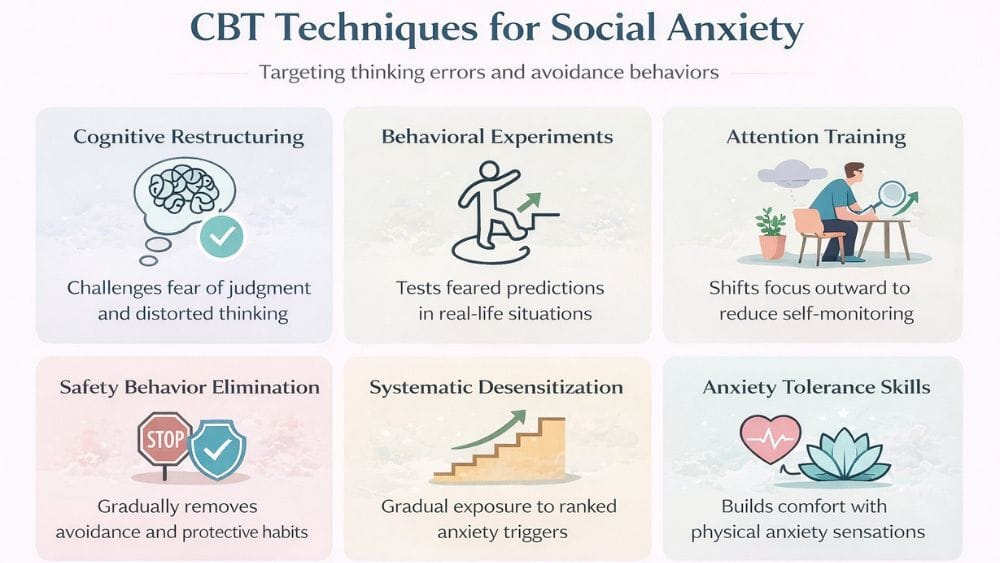
CBT relies on specific tools designed to weaken anxiety-maintaining processes. These CBT techniques for social anxiety disorder address both thinking errors and avoidance behaviors.
Cognitive Restructuring for Fear of Judgment
Social anxiety is driven by automatic negative thoughts, such as assuming others view you as incompetent or strange. Cognitive restructuring teaches you to identify these thoughts, examine evidence, and replace assumptions with more accurate interpretations.
This technique does not promote forced positivity. It trains realistic thinking based on observable facts. Over time, reduced cognitive distortion lowers anticipatory anxiety and post-event self-criticism.
Behavioral Experiments
Behavioral experiments test feared predictions in real situations. For example, you might predict that speaking up will lead to ridicule. The experiment involves speaking briefly and observing the actual outcome.
Repeated experiments weaken catastrophic beliefs more effectively than reassurance. This learning process strengthens the impact of cognitive behavioral therapy for social anxiety .
Attention Training Techniques
Social anxiety shifts attention inward toward physical sensations and perceived flaws. Attention training redirects focus outward to the task, conversation, or environment. This reduces self-monitoring, which intensifies anxiety.
By changing attention patterns, anxiety loses one of its key fuel sources.
Safety Behavior Elimination
Safety behaviors include actions meant to prevent embarrassment, such as avoiding eye contact, rehearsing sentences excessively, or speaking quietly. These behaviors maintain anxiety because they block learning.
CBT gradually removes safety behaviors so you experience social situations without protective crutches. Confidence increases as you learn that feared outcomes do not depend on these behaviors.
Systematic Desensitization
Systematic desensitization combines gradual exposure with anxiety tolerance skills. Situations are ranked from least to most anxiety-provoking, then faced in sequence. Anxiety naturally decreases with repetition.
CBT Exercises for Social Anxiety
Without consistent practice, progress remains limited. Effective CBT exercises for social anxiety are structured, measurable, and repeated over time.
Thought Records for Social Situations
Thought records capture anxious predictions before or after social interactions. They include the situation, automatic thought, emotional response, supporting evidence, and alternative interpretation.
This exercise builds awareness of thinking patterns and improves emotional regulation.
Fear Hierarchy Creation
A fear hierarchy organizes social situations by anxiety level. This tool guides exposure planning and prevents avoidance-driven pacing. Starting with manageable tasks increases success and motivation.
Exposure Exercises for Social Interactions
Exposure exercises involve planned engagement in feared situations without avoidance. Examples include initiating conversations, expressing disagreement, or speaking in meetings. Each exposure continues until anxiety decreases on its own.
Role-Playing and Social Rehearsal
Role-playing allows practice in a controlled setting. Therapists provide feedback on clarity, volume, and posture. This improves skill confidence before real-world exposure.
These CBT exercises for social anxiety strengthen learning and prepare you for daily social demands.
CBT Treatment for Social Anxiety
CBT treatment depends on symptom severity, avoidance level, and functional impairment.
Clinical practice shows that structured CBT protocols produce better outcomes than unstructured talk therapy. The effectiveness of cognitive behavioral therapy for social anxiety increases when treatment includes clear goals, regular exposure tasks, and therapist-guided feedback.
Assessment and Goal Setting
Assessment begins with identifying feared situations, avoidance patterns, and distorted beliefs. Clinicians evaluate symptom intensity, physical anxiety responses, and functional impairment in work, education, or relationships. This phase ensures that treatment targets behaviors that maintain anxiety rather than surface discomfort.
Goal setting focuses on functional outcomes, not symptom elimination. Examples include attending meetings, initiating conversations, or tolerating uncertainty during social interactions. Clear goals guide exposure planning and help track progress during CBT treatment for social anxiety .
Session Structure and Frequency
Standard CBT sessions last 45 to 60 minutes and occur weekly. Each session follows a predictable structure: review of homework, discussion of challenges, skill refinement, and planning new exposure tasks. This structure supports learning and accountability.
Irregular scheduling weakens treatment effects. Regular sessions allow anxiety learning to consolidate. In clinical settings, cognitive behavioral therapy for social anxiety shows better outcomes when sessions remain consistent throughout treatment.
Homework and Real-World Exposure Tasks
Assignments include exposure tasks, thought monitoring, and safety behavior reduction. These tasks ensure that learning occurs in real environments rather than only in therapy sessions.
Patients who complete homework consistently show faster improvement and lower relapse rates. Exposure outside sessions is essential for lasting change within CBT treatment for social anxiety .
Duration of CBT for Social Anxiety
Most structured CBT programs last 12 to 16 sessions. Some individuals with long-standing symptoms or severe avoidance may require extended treatment. Progress depends on engagement, not time alone.
Symptom reduction often begins within the first month. Functional improvement continues as exposure tasks increase in complexity during cognitive behavioral therapy for social anxiety .
Effectiveness of CBT for Social Anxiety
CBT is widely regarded as the most effective psychological treatment for social anxiety disorder. Its success lies in targeting the mechanisms that maintain fear rather than masking symptoms. Long-term outcomes consistently favor CBT over non-structured interventions.
Cognitive behavioral therapy for social anxiety produces sustained improvement, even after treatment ends. Unlike symptom-focused approaches, CBT equips you with tools to manage future stressors independently.
Evidence From Clinical Studies
Controlled trials repeatedly demonstrate significant reductions in avoidance, fear intensity, and functional impairment following CBT. Improvements occur across individual, group, and online formats when exposure remains central.
Brain imaging research also shows reduced threat activation after CBT, supporting its role in modifying fear processing pathways rather than simply suppressing anxiety responses.
Long-Term Outcomes and Relapse Prevention
Long-term follow-up studies indicate that CBT gains persist for years. Patients retain skills such as cognitive restructuring and exposure planning, which protect against relapse during stressful life events.
Relapse prevention strategies focus on early recognition of avoidance and continued use of exposure. These strategies strengthen the durability of cognitive behavioral therapy for social anxiety .
CBT vs Medication for Social Anxiety
Medication reduces symptoms while taken, but does not change avoidance patterns. CBT addresses the underlying fear-learning process. When medication stops, symptoms often return unless CBT skills are present.
For moderate cases, CBT alone often matches or exceeds medication outcomes. Combined treatment may benefit severe cases, but does not replace the core role of CBT.
Risks of CBT for Social Anxiety
CBT is safe when delivered by trained professionals, but it involves discomfort. Understanding risks of CBT for social anxiety helps set realistic expectations and improves treatment adherence.
Discomfort during therapy reflects exposure to feared situations rather than harm. Avoiding this discomfort reduces effectiveness and prolongs anxiety.
Temporary Increase in Anxiety During Exposure
Anxiety often increases during early exposure tasks. This response is expected and short-term. Fear decreases through repetition, not avoidance.
Stopping exposure early reinforces anxiety. Continued practice allows the nervous system to recalibrate during cognitive behavioral therapy for social anxiety .
Emotional Discomfort During Sessions
Discussing feared beliefs and engaging in exposure can cause emotional strain. This discomfort indicates engagement with anxiety triggers rather than treatment failure. Therapists monitor distress levels to ensure exposures remain tolerable and productive.
Limitations for Severe Comorbid Conditions
Severe depression, active substance misuse, or psychotic symptoms may interfere with CBT participation. These conditions often require stabilization before CBT begins. In such cases, CBT may proceed alongside additional interventions to reduce risks of CBT for social anxiety .
When CBT May Need Medication Support
Medication may help reduce symptom intensity when anxiety prevents exposure participation. This support allows engagement with CBT tasks.
Medication alone does not replace CBT and should support skill development rather than avoidance.
When to Seek Professional Help
Professional treatment becomes necessary when social anxiety interferes with daily functioning. Early intervention reduces long-term impairment and prevents symptom escalation.
Self-help strategies may help mild anxiety but often fail when avoidance spreads across multiple areas of life.
Signs Social Anxiety Is Worsening
Increasing avoidance, heightened physical symptoms, and expanding fear triggers indicate progression. These signs suggest that anxiety learning is strengthening without intervention. Professional CBT treatment for social anxiety interrupts this progression.
Impact on Work, Relationships, or Education
Missed opportunities, isolation, and declining performance signal functional impairment. These effects often persist even when anxiety seems manageable internally. CBT targets both symptoms and functioning, restoring participation in daily life.
When Self-Help CBT Is Not Enough
Books and apps lack feedback and exposure guidance. Therapist-led CBT adjusts strategies based on real-time responses and obstacles. This guidance improves outcomes in cognitive behavioral therapy for social anxiety .
FAQs
Is Cognitive Behavioral Therapy Effective for Social Anxiety?
Yes. Cognitive behavioral therapy for social anxiety consistently reduces avoidance, fear intensity, and functional impairment. Clinical trials show improvement in social functioning that lasts beyond treatment completion.
How Long Does CBT Take to Work for Social Anxiety?
Improvement usually begins within 4 to 6 sessions. Meaningful functional changes often appear by 8 to 12 weeks when exposure tasks are completed consistently during cognitive behavioral therapy for social anxiety .
Can CBT Completely Cure Social Anxiety Disorder?
No. CBT does not erase vulnerability. It provides durable control by changing fear responses and behavior patterns, allowing long-term management through skills learned in cognitive behavioral therapy for social anxiety .
Is Group CBT Effective for Social Anxiety?
Yes. Group-based cognitive behavioral therapy for social anxiety is effective, especially for interpersonal fears. Live social exposure and peer feedback strengthen learning and reduce self-focused attention.
What Are Common CBT Exercises for Social Anxiety?
Common CBT exercises for social anxiety include thought records, graded exposure, safety behavior elimination, role-playing, and rumination control. These exercises directly target fear maintenance mechanisms.
Is Exposure Therapy Necessary in CBT for Social Anxiety?
Yes. Exposure is essential. Without exposure, avoidance persists and anxiety remains active. Exposure retrains fear responses, making it the most critical component of cognitive behavioral therapy for social anxiety .
Can CBT Be Done Online for Social Anxiety?
Yes. Guided online programs using CBT techniques for social anxiety disorder show strong outcomes for mild to moderate cases, especially when therapist feedback supports exposure adherence.
What Are the Risks of CBT for Social Anxiety?
The main risks of CBT for social anxiety include temporary anxiety increases and emotional discomfort during exposure. These effects are expected and resolve with continued practice.
How Does CBT Compare to Medication for Social Anxiety?
CBT produces longer-lasting improvement than medication. Medication reduces symptoms temporarily, while cognitive behavioral therapy for social anxiety changes fear learning and reduces relapse risk.
Who Should Not Use CBT for Social Anxiety?
People with untreated psychosis, severe cognitive impairment, or active substance dependence may require stabilization first. CBT works best when attention, insight, and behavioral participation are possible.
About The Author

Medically reviewed by Dr. Chandril Chugh, MD, DM (Neurology)
Dr. Chandril Chugh is a U.S.-trained, board-certified neurologist with expertise in diagnosing and managing neurological disorders, including migraines, epilepsy, Parkinson’s disease, and movement disorders. His clinical focus includes evidence-based neurological care and patient education.
All content is reviewed for medical accuracy and aligned with current neurological guidelines.