Insomnia and ADHD are not just two separate problems that happen to coexist. They are biologically connected. The same brain chemistry that drives ADHD symptoms during the day also prevents the brain from shutting down at night.
Studies show that 75% of adults with ADHD report chronic sleep problems. Most of them struggle to fall asleep before 1 or 2 AM, even when exhausted. The next morning, waking up feels nearly impossible. This is a neurological pattern.
Key Takeaways
- Insomnia and ADHD co-occur in up to 75% of adults with the condition.
- Low dopamine in ADHD delays melatonin release by 1.5 to 2 hours compared to neurotypical adults.
- ADHD and delayed sleep phase disorder are closely linked. Most adults with ADHD are biologically wired as night owls.
- CBT for Insomnia (CBT-I) outperforms sleep medication for long-term results in adults with ADHD.
- Stimulant medications taken too late in the day worsen sleep onset by 30 to 60 minutes.
Why Insomnia Is Common in Adults With ADHD
ADHD causes insomnia. The neurological structure of ADHD directly disrupts the systems that regulate sleep.
Hyperactive Mind at Night
The ADHD brain does not sleep at bedtime. Racing thoughts, random associations, and unfinished mental loops keep the brain in an active state long after the body lies down. It is the ADHD default mode network running without interruption.
Dopamine and Melatonin Imbalance
Dopamine controls the brain’s reward and timing systems. In ADHD, dopamine levels drop in the evening when they should be stabilizing. This disrupts melatonin production. Research published in the Journal of Sleep Research found that adults with ADHD produce melatonin 1.5 hours later than non-ADHD adults on average.
Time Blindness and Poor Bedtime Routine
Time blindness is a core ADHD trait. Adults with ADHD genuinely do not feel time passing. 11 PM arrives and feels like 9 PM. Bedtime routines never get started because the brain does not register the hour shifting.
Emotional Dysregulation at Night
The ADHD brain struggles to regulate emotions throughout the day. At night, with no tasks to focus on, unprocessed emotions surface. Arguments, perceived failures, and unresolved stress all replay at bedtime.
Anxiety and ADHD Sleep Problems
Anxiety and ADHD sleep problems often feed each other. Around 50% of adults with ADHD also have an anxiety disorder. Anxiety raises cortisol at night. Cortisol and melatonin directly oppose each other. Higher cortisol means later, shallower sleep.
ADHD and Delayed Sleep Phase Disorder
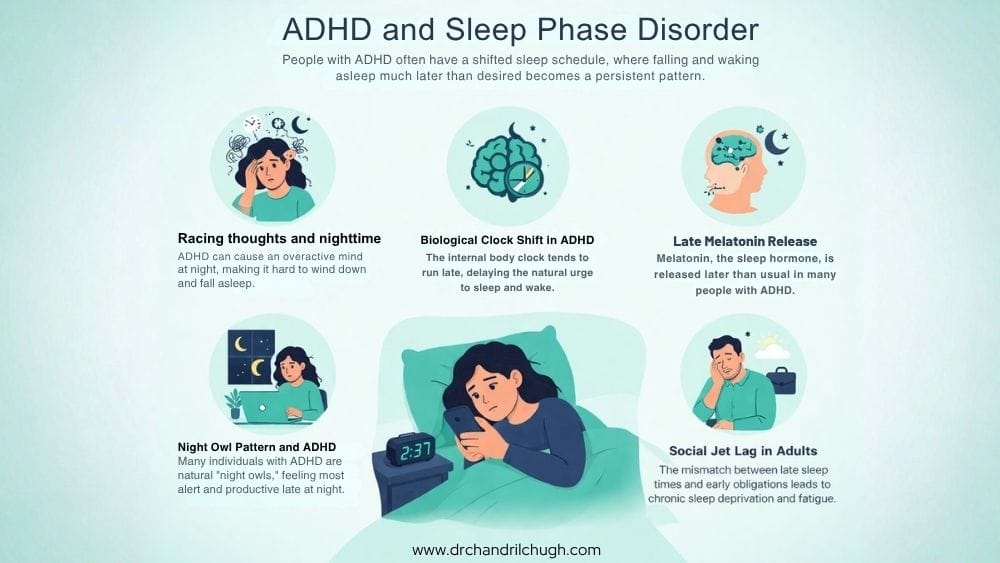
ADHD and delayed sleep phase disorder share the same biological root. Both involve a shifted circadian clock that runs 2 to 3 hours behind the standard 24-hour schedule.
What Is Delayed Sleep Phase Disorder?
Delayed Sleep Phase Disorder (DSPD) is a circadian rhythm condition where the body’s sleep-wake cycle shifts significantly later than normal. A person with DSPD naturally falls asleep at 2 or 3 AM and wakes up around 10 or 11 AM. The sleep itself is normal in quality. The timing is the problem.
Biological Clock Shift in ADHD
Research from the Netherlands Institute for Neuroscience found that 73% of adults with ADHD showed signs of delayed circadian rhythms. The body clock in ADHD consistently runs late, making early morning starts biologically difficult.
Late Melatonin Release
In typical adults, the brain starts releasing melatonin around 9 PM. In adults with ADHD and delayed sleep phase disorder, melatonin release starts closer to 10:30 or 11 PM. This single delay pushes the entire sleep window 90 minutes backward.
Night Owl Pattern and ADHD
Many adults with insomnia and ADHD report their best hours of focus and productivity between 10 PM and 2 AM. This is not a lifestyle choice. The ADHD brain’s dopamine activity peaks late in the evening for many people.
Social Jet Lag in Adults
Social jet lag happens when a person’s natural sleep timing conflicts with social or work schedules. Adults with ADHD experience chronic social jet lag, essentially living in a different time zone from the rest of the world, every single day.
Difficulty Waking Up in the Morning: ADHD Sleep Pattern
Difficulty waking up in the morning with ADHD is one of the most reported and least addressed symptoms in adults with the condition.
Sleep Inertia in ADHD
Sleep inertia is the groggy, disoriented state right after waking. Everyone experiences it briefly. Adults with ADHD experience it for 1 to 4 hours. During this window, cognitive function is severely impaired, even if the person is technically awake.
Deep Sleep Dysregulation
Research shows that adults with ADHD spend more time in deep slow-wave sleep compared to neurotypical adults, and they enter it later in the sleep cycle. Waking from deep sleep produces intense grogginess. Being woken by an alarm during this phase makes morning functioning nearly impossible.
Circadian Misalignment
When the body’s natural wake time is 9 or 10 AM, a 7 AM alarm forces the person to wake during the body’s deepest biological sleep period. The difficulty waking up in morning with ADHD pattern is about being woken at the wrong biological time, repeatedly.
Alarm Fatigue and Oversleeping
Adults with ADHD often set 8 to 12 alarms and still oversleep. The brain habituates to the alarm sound within days. Some adults report sleeping through alarms they do not even remember hearing.
Types of Sleep Problems Seen in ADHD
Insomnia and ADHD do not always look the same. Several distinct sleep disorders appear at higher rates in people with ADHD.
Sleep-Onset Insomnia
This is the most common type. The person lies awake for 1 to 3 hours before falling asleep, despite feeling tired.
Restless Legs Syndrome
Adults with ADHD have 2 to 3 times higher rates of Restless Legs Syndrome (RLS) than the general population. Both conditions involve dopamine dysregulation. The urge to move the legs disrupts sleep onset and early sleep stages.
Sleep-Disordered Breathing
Sleep apnea appears more frequently in adults with ADHD. Untreated sleep apnea produces fragmented sleep that mimics ADHD symptoms, creating a cycle where both conditions worsen each other.
Narcolepsy Overlap
A subset of adults diagnosed with ADHD shows excessive daytime sleepiness that does not respond to stimulant medication. Some of these cases involve undiagnosed narcolepsy, a separate sleep disorder requiring different treatment.
Fragmented Sleep
Many adults with insomnia and ADHD fall asleep eventually but wake multiple times. They do not always remember waking. They wake up feeling unrefreshed despite 8 hours in bed.
Anxiety and ADHD Sleep Problems
Anxiety and ADHD sleep problems create a specific pattern that standard sleep advice does not address.
Rumination at Bedtime
The ADHD brain without stimulation at night defaults to problem-solving mode. Unfinished tasks, social interactions, and future plans all get processed at full speed at 1 AM.
Performance Anxiety and Next-Day Stress
Adults with ADHD often experience anticipatory anxiety at bedtime. They worry about being late, forgetting things, or underperforming. This anxiety delays sleep onset further.
Sensory Sensitivity
Many adults with ADHD have heightened sensory sensitivity. Minor sounds, light through curtains, or physical discomfort that neurotypical sleepers ignore become impossible to block out.
Trauma-Related Hyperarousal
A significant portion of adults with insomnia and ADHD also carry trauma histories. Hyperarousal from PTSD or complex trauma amplifies all ADHD sleep difficulties. The nervous system stays in high-alert mode regardless of exhaustion level.
Diagnosis of Sleep Disorders in ADHD
Clinical Sleep History
A sleep specialist takes a full history covering sleep timing, daytime function, medication use, and symptom patterns. Most ADHD sleep problems are diagnosed clinically, not through lab tests.
Sleep Diary
A two-week sleep diary tracking bedtime, wake time, and perceived sleep quality gives the clearest real-world picture of the sleep pattern.
Actigraphy
Actigraphy is a wristband device that tracks movement over 7 to 14 days. It objectively measures the circadian rhythm pattern and confirms a delayed sleep phase.
Polysomnography
An overnight sleep study measures brain waves, breathing, and movement during sleep. It is used when sleep apnea or narcolepsy is suspected.
Screening for Comorbid Anxiety
Because anxiety and ADHD sleep problems overlap significantly, clinicians screen for generalized anxiety disorder and PTSD before finalizing a sleep treatment plan.
Sleep Strategies for Adults With ADHD
The most effective sleep strategies for adults with ADHD work with the ADHD brain rather than against it.
Fixed Wake-Up Time Strategy
Pick one consistent wake time and hold it every day, including weekends. This is the single most effective circadian reset tool. The wake time trains the body clock faster than any other intervention.
Melatonin Timing Optimization
Low-dose melatonin (0.5 mg to 1 mg) taken 90 minutes before the desired sleep time shifts the circadian clock earlier. Higher doses produce grogginess without better sleep. Most people with insomnia and ADHD take too high a dose too late.
Digital Sunset Rule
Blue light from screens suppresses melatonin. The ADHD brain is especially sensitive to stimulating content at night. A hard stop on screens 60 minutes before bed, combined with blue light glasses, if needed, reduce sleep onset time by 30 to 45 minutes in clinical studies.
Body-Based Wind-Down Routine
The ADHD brain responds better to physical cues than mental intentions. A hot shower 90 minutes before bed drops core body temperature, which signals sleep onset. This is a proven biological trigger, not a wellness trend.
Structured Bedtime Cueing
Use the same sequence every night. Brush teeth, dim lights, take melatonin, and use the same playlist or white noise. Repetition builds an automatic sleep association the ADHD brain eventually follows.
Morning Light Therapy
10 minutes of bright light exposure (10,000 lux light box) within 30 minutes of waking shifts the circadian clock earlier over 2 to 3 weeks. This is one of the most evidence-backed sleep strategies for adults with ADHD and delayed sleep phase.
Cognitive Behavioral Therapy for Insomnia (CBT-I)
CBT-I is the gold standard treatment for chronic insomnia. It outperforms sleep medication in long-term studies. For adults with insomnia and ADHD, CBT-I combined with circadian interventions produces better outcomes than medication alone.
When to See a Sleep Specialist
- Insomnia persists for more than 3 months despite consistent sleep hygiene attempts
- Loud snoring, gasping, or breathing pauses during sleep suggest sleep apnea
- Morning impairment lasts more than 2 hours and affects work or daily tasks
- ADHD stimulant medication adjustment has not resolved sleep issues after 8 weeks
Sleep specialists with experience in both circadian disorders and ADHD produce the best outcomes for this population.
FAQs
Does ADHD cause insomnia?
Yes, ADHD causes insomnia. Low dopamine delays melatonin release by 1.5 hours. The hyperactive ADHD mind cannot stop at bedtime. Sleep-onset insomnia affects 75% of adults with ADHD, making it a neurological symptom, not a habit problem.
Why do adults with ADHD struggle to fall asleep?
The ADHD brain produces melatonin 90 minutes later than average. The default mode network stays active without stimulation. Racing thoughts, sensory sensitivity, and dopamine drops in the evening all combine to delay sleep onset in insomnia and ADHD cases.
What is ADHD and delayed sleep phase disorder?
ADHD and delayed sleep phase disorder are circadian rhythm conditions where the body clock runs 2 to 3 hours late. 73% of adults with ADHD show delayed circadian rhythms. Sleep quality is normal, but the timing is shifted, making early mornings biologically painful.
Why is it hard to wake up in the morning with ADHD?
Difficulty waking up in morning with ADHD happens because the ADHD body clock peaks sleep depth during standard morning hours. Sleep inertia lasts 1 to 4 hours. Adults wake during deep slow-wave sleep, producing intense grogginess that medication does not immediately fix.
Can anxiety make ADHD sleep worse?
Yes. Anxiety and ADHD sleep problems compound each other. Anxiety raises cortisol at night. Cortisol blocks melatonin. Adults with both ADHD and anxiety disorder take an average of 90 additional minutes to fall asleep compared to adults with ADHD alone.
Do stimulant medications cause insomnia?
Yes, when taken too late. Methylphenidate and amphetamines taken after 2 PM delay sleep onset by 30 to 60 minutes on average. Morning dosing, before 8 AM, reduces this effect significantly. Some adults with insomnia and ADHD find that low-dose stimulants taken at the right time actually improve sleep by reducing evening ADHD hyperarousal.
What is the best sleep strategy for adults with ADHD?
The most effective single sleep strategy for adults with ADHD is a fixed wake time combined with 0.5 mg melatonin taken 90 minutes before the target sleep time. Adding morning light therapy with a 10,000 lux box shifts the circadian clock earlier within 2 weeks.
Is melatonin safe for ADHD sleep problems?
Yes, at low doses. 0.5 mg to 1 mg is effective and safe for adults with insomnia and ADHD. Doses above 3 mg produce next-morning grogginess without improving sleep quality. Melatonin treats the circadian delay. It does not treat sleep-onset anxiety or hyperarousal, which need separate interventions.
How common are sleep disorders in ADHD?
Sleep disorders affect 75% of adults with insomnia and ADHD. Restless Legs Syndrome appears at 2 to 3 times the normal rate. Sleep apnea and delayed sleep phase disorder also show significantly higher prevalence. Most adults with ADHD have at least one diagnosable sleep condition alongside the ADHD itself.
About The Author

Medically reviewed by Dr. Chandril Chugh, MD, DM (Neurology)
Dr. Chandril Chugh is a U.S.-trained, board-certified neurologist with expertise in diagnosing and managing neurological disorders, including migraines, epilepsy, Parkinson’s disease, and movement disorders. His clinical focus includes evidence-based neurological care and patient education.
All content is reviewed for medical accuracy and aligned with current neurological guidelines.