Getting over a breakup is a neurological process. Your brain reacts to a breakup the same way it reacts to physical pain and drug withdrawal combined.
Key Takeaways
- Breakup pain activates the same brain regions as physical injury.
- Dopamine and oxytocin withdrawal cause real craving symptoms after a relationship ends.
- The stages of breakup recovery are non-linear. You will not go through them in order.
- No contact is the single most evidence-backed step in the early recovery phase.
- Healing after a toxic relationship takes longer because trauma bonds alter brain chemistry.
- You may return to emotional baseline within 3 to 6 months with active recovery steps.
- Rumination and social media checking are the two biggest behaviors that slow healing.
Why Breakups Hurt So Much Psychologically
Understanding why breakups hurt so much psychologically helps you stop treating the pain as weakness.
Attachment System Activation
Humans are wired to bond. When a close relationship ends, the brain’s attachment system fires distress signals. These are the same signals that fire when a child is separated from a caregiver. The brain reads the loss as a survival threat, not just a social inconvenience.
Dopamine Withdrawal
In a relationship, your brain releases dopamine every time you see, text, or think about your partner. When the relationship ends, that dopamine stops. The result is literal withdrawal. Cravings, restlessness, and obsessive thinking are all dopamine deficits in action.
Rejection and Social Pain Circuits
A 2011 Columbia University study used fMRI scans to confirm that romantic rejection activates the same brain regions as physical burns. The anterior cingulate cortex, which processes physical pain, lights up during social rejection. This is why breakups hurt so much psychologically at a level far beyond just feeling sad.
Rumination and Memory Loops
The brain stores relationship memories in the hippocampus and prefrontal cortex. After a breakup, it replays those memories repeatedly to try to “solve” the loss. It is an automatic cognitive loop designed to prevent future threats, but it keeps the pain alive longer than necessary.
Identity Disruption
Long relationships reshape personal identity. You start using “we” instead of “I.” Your goals, routines, and social circle all revolve around the other person. When the relationship ends, you lose a version of yourself, too. This identity disruption is a major but underreported reason for prolonged recovery.
The Stages of Breakup Recovery
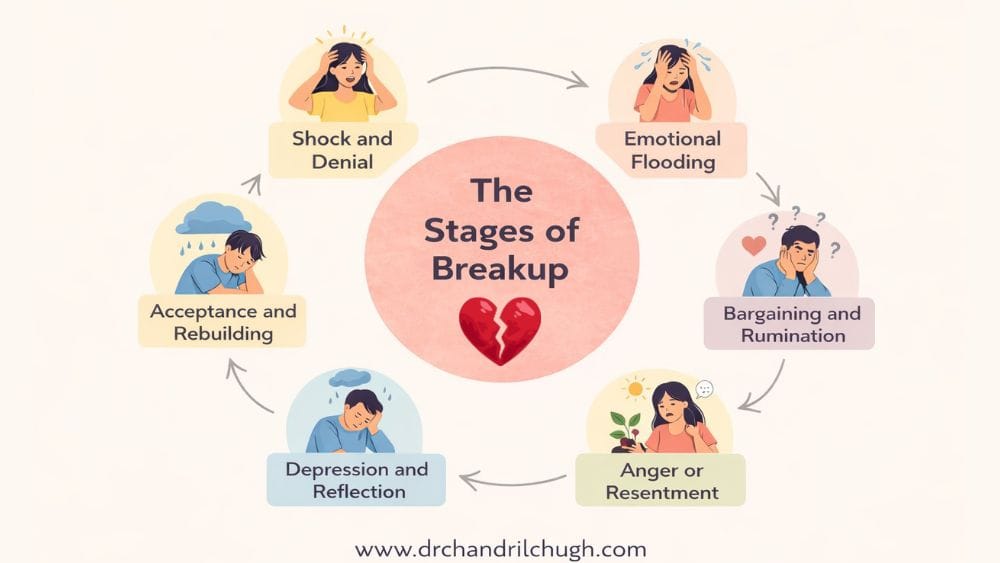
The stages of breakup recovery do not follow a neat timeline. You may cycle back and forth between stages before finding stability.
Shock and Denial
The first few hours or days feel unreal. The brain protects itself by numbing the full impact of the loss. This phase can feel calm, but it is suppression, not acceptance.
Emotional Flooding
Once the shock fades, emotion hits hard. Crying, chest tightness, difficulty breathing, and sleep disruption all show up here. This is the brain processing what it could not absorb during the denial phase.
Bargaining and Rumination
“What if I had done this differently?” This stage is driven by the brain’s problem-solving mode, trying to reverse an irreversible outcome. It is mentally exhausting and often the longest stage.
Anger or Resentment
Anger often arrives after bargaining. It is a healthy shift from helplessness to agency. The risk here is staying in anger too long, which blocks rebuilding.
Acceptance and Rebuilding
Acceptance does not mean you are happy the relationship ended. It means you stop fighting the reality of it. Rebuilding starts here, with small daily actions that reinforce a new identity.
The stages of breakup recovery are non-linear. You can go from acceptance back to anger in a single day.
14 Expert Tips to Help You Get Over Someone
These are the 14 expert tips to help you get over someone grounded in psychological research. If you are serious about how to get over a breakup for good, apply these in order during the first 60 days.
1. Cut or Limit Contact
No contact is not about punishing your ex. It is the most evidence-backed first step to get over a breakup. Every text, call, or check-in resets the dopamine withdrawal clock back to zero.
2. Remove Digital Triggers
Unfollow, mute, or archive. Seeing your ex’s posts activates the same pain circuits as direct rejection. Out of sight reduces rumination frequency significantly.
3. Allow Structured Grieving
Set 15 to 20 minutes per day to feel the pain fully. Outside that window, redirect. This prevents grief from taking over the full day while still allowing emotional processing.
4. Avoid Immediate Rebound Decisions
Rebound relationships formed within 30 days of a breakup rarely help to get over a breakup properly. They delay the pain, not resolve it. The brain needs time to recalibrate its reward pathways before a new attachment is healthy. This is one of the least-followed of the 14 expert tips to help you get over someone, but one of the most important.
5. Rebuild Daily Routine
Structure reduces anxiety. Fixed wake times, meals, and work hours rebuild the sense of control that the breakup disrupted.
6. Sleep and Nutrition Stabilization
Cortisol spikes after a breakup disrupt sleep and suppress appetite. Prioritizing 7 to 8 hours of sleep and regular protein-rich meals directly stabilizes mood chemistry.
7. Limit Rumination Time
Ruminating for more than 30 minutes at a stretch increases depression risk by 35%, per Harvard Medical School research. Use physical interruption to stop the loop: cold water, a 5-minute walk, or a simple task.
8. Journal Emotional Patterns
Writing about the relationship, including its real problems and not just its good moments, reduces idealization and speeds emotional processing.
9. Seek Social Support
In-person social interaction raises oxytocin levels, which drop sharply after a breakup. Phone calls are second best. Texting alone does not produce the same neurochemical benefit.
10. Challenge Idealization
The brain edits memories after a breakup to highlight only the good parts. Write a realistic list of the relationship’s actual problems. This counters the idealization loop directly.
11. Move Your Body
Exercise increases BDNF (brain-derived neurotrophic factor), which rebuilds neural pathways damaged by chronic stress. 30 minutes of aerobic exercise 4 times per week produces measurable mood improvement within 2 weeks.
12. Set Short-Term Personal Goals
Small goals rebuild identity outside the relationship. One new weekly goal creates forward momentum and shifts focus from the past to the present.
13. Seek Therapy if Needed
Cognitive Behavioral Therapy (CBT) and Acceptance and Commitment Therapy (ACT) both show strong results for breakup-related distress. If you are still struggling with how to get over a breakup after 6 months without improvement, professional support is the right step.
14. Redefine Identity Without the Relationship
List who you were before the relationship. Interests, goals, friendships, and habits that faded during the relationship. Rebuild from that list. Identity reconstruction is the final step in 14 expert tips to help you get over someone for a reason. It is the most lasting form of recovery.
Healing After a Toxic Relationship
Healing after a toxic relationship takes longer than healing from a healthy one. Toxic relationships rewire brain chemistry through intermittent reinforcement, which is the same mechanism behind gambling addiction.
Trauma Bond Withdrawal
Trauma bonds form when a relationship alternates between extreme highs and painful lows. The brain becomes dependent on the highs to offset the lows. Leaving feels physically unbearable, even when the relationship was harmful.
Rebuilding Self-Esteem
Toxic relationships systematically erode self-worth. Recovery requires deliberate self-esteem rebuilding through consistent small actions, completed goals, and selective social environments.
Recognizing Gaslighting Effects
Gaslighting causes people to distrust their own memory and judgment. After leaving, many survivors second-guess basic perceptions. Journaling daily events helps rebuild trust in your own thinking.
Boundary Reconstruction
Toxic relationships often normalize boundary violations. Identifying the specific boundaries that were crossed and practicing setting them with safe people is the core work of healing after a toxic relationship.
When Professional Help Is Necessary
Seek a therapist trained in trauma-informed care when you experience flashbacks, hypervigilance, persistent shame, or inability to function for 3 or more months after the relationship ended. EMDR and somatic therapy are effective for relationship trauma specifically.
Dealing With Breakup Anxiety and Sadness
Dealing with breakup anxiety and sadness requires understanding that these are physiological responses, not signs of weakness or over-attachment. People who recognize this heal faster than those who judge themselves for feeling it.
Panic-Like Symptoms
Chest tightness, shortness of breath, and a racing heart after a breakup are caused by cortisol and adrenaline spikes. They feel alarming.
Sleep Disruption
Cortisol peaks at night after a breakup, which delays sleep onset. A consistent sleep schedule and reducing screen time 60 minutes before bed lowers cortisol enough to improve sleep within 7 to 10 days.
Appetite Changes
Both appetite loss and stress eating are normal responses. Eating 3 small protein-rich meals daily maintains blood sugar stability, which directly affects mood.
Intrusive Thoughts
Intrusive thoughts about your ex are involuntary and a core symptom of dealing with breakup anxiety and sadness. They reduce in frequency within 4 to 8 weeks when you consistently redirect attention using physical activity or task completion.
Emotional Waves
Emotions after a breakup arrive in waves, not as a steady state. Grounding techniques help during peaks: 4-count box breathing (inhale 4, hold 4, exhale 4, hold 4) lowers cortisol within 90 seconds. The 5-4-3-2-1 sensory method (name 5 things you see, 4 you hear, 3 you can touch) interrupts emotional flooding immediately.
Common Mistakes That Delay Healing
These mistakes are the most common reasons people stay stuck. Each one directly disrupts the neurological recovery process.
Checking Social Media Repeatedly
Every time you check your ex’s profile, you re-trigger the rejection pain circuit. It resets the healing clock. Research shows obsessive profile-checking prolongs recovery by an average of 2 to 4 weeks.
Staying in Contact Too Soon
“Staying friends” in the first 60 days prevents the dopamine detox the brain needs. Most successful post-breakup friendships begin after both people have fully processed the loss separately.
Idealizing the Past
The brain filters out the relationship’s problems after a breakup. Unchecked idealization turns an average or painful relationship into something that feels irreplaceable. It is not an accurate memory. It is a cognitive distortion.
Avoiding Grief
Suppressing grief does not remove it. It stores it. People learning to get over a breakup and avoid processing the pain often experience delayed grief months later, triggered by unrelated events. Avoidance always costs more time than it saves.
Jumping Into Another Relationship
Entering a new relationship before processing the previous one transfers unresolved emotional patterns into the new dynamic. Getting over a breakup properly means doing the internal work first.
Frequently Asked Questions
How do you get over a breakup faster?
Getting over a breakup faster requires four specific actions: immediate no contact; removing digital triggers; structured daily grieving (15 to 20 minutes only), and rebuilding a physical routine. Research shows people who combine these four steps recover 40% faster than those who rely on time alone.
Why do breakups hurt so much psychologically?
Breakups come down to three brain systems firing at once: dopamine withdrawal stops the reward circuit, oxytocin drops remove bonding chemistry, and the anterior cingulate cortex processes social rejection as physical pain. It is neurologically identical to substance withdrawal combined with a physical injury.
What are the stages of breakup recovery?
The stages of breakup recovery are shock, emotional flooding, bargaining and rumination, anger, and acceptance. They are non-linear. Most people cycle back through earlier stages multiple times before reaching stable acceptance. Average full cycle completion takes 3 to 6 months.
How long does it take to get over someone?
Research from the University of Missouri found that most people feel significantly better 3 months after a breakup. Full emotional baseline recovery takes 6 to 12 months for long-term relationships. Toxic relationships take 12 to 24 months due to trauma bond chemistry.
How do I stop thinking about my ex?
Stop the rumination loop with physical interruption: cold water on the face, a brisk 10-minute walk, or shifting to a task requiring verbal output like reading aloud. Thought suppression (“don’t think about them”) increases frequency. Redirection to a specific physical task decreases it.
How do you heal after a toxic relationship?
Healing after a toxic relationship requires three steps first: naming the specific manipulation patterns that occurred, rebuilding trust in your own judgment through daily journaling, and re-establishing at least one physical boundary with a safe person each week. Therapy is not optional for severe cases; it is the fastest route.
Is it normal to feel anxious after a breakup?
Yes. Anxiety after a breakup is a cortisol and adrenaline response to perceived threat. The brain registers attachment loss as a survival event. Box breathing (4-count inhale, hold, exhale, hold) reduces cortisol within 90 seconds and is the most evidence-backed immediate intervention.
Should you stay friends with your ex?
No, not immediately. Friendship within the first 60 days prevents dopamine detox and prolongs recovery. Studies show post-breakup friendships that start after 6 months of separation have a significantly higher success rate and do not reactivate the same pain circuits as early contact does.
Why does breakup pain feel physical?
Breakup pain feels physical because it is. The anterior cingulate cortex processes social rejection the same way it processes a burn or a cut. A 2011 Columbia University fMRI study confirmed this. Physical pain and social pain share the same neural processing pathway.
How do I rebuild confidence after a breakup?
Rebuild confidence by completing 1 small goal per day for 30 days. Completed goals raise dopamine baseline. Simultaneously, list 5 qualities you had before the relationship that the relationship did not create. Confidence tied to self-reference, not to another person, does not collapse when relationships end.
About The Author

Medically reviewed by Dr. Chandril Chugh, MD, DM (Neurology)
Dr. Chandril Chugh is a U.S.-trained, board-certified neurologist with expertise in diagnosing and managing neurological disorders, including migraines, epilepsy, Parkinson’s disease, and movement disorders. His clinical focus includes evidence-based neurological care and patient education.
All content is reviewed for medical accuracy and aligned with current neurological guidelines.