Key Takeaways
- A sleep apnea mouthpiece is a small oral device worn during sleep to keep your airway open.
- It works by pushing the lower jaw forward or holding the tongue in place.
- Works best for mild to moderate obstructive sleep apnea (OSA).
- Custom-fitted devices from a dentist outperform cheap store-bought ones.
- Side effects are usually short-term and manageable.
- It is a strong CPAP alternative for people who cannot tolerate the mask.
How Does a Sleep Apnea Mouthpiece Work?
A sleep apnea mouthpiece works by physically changing the position of your jaw or tongue while you sleep. Both methods keep your airway from collapsing.
Mandibular Advancement Mechanism
The jawbone is called the mandible. When a device moves slightly forward, the muscles and tissues around the throat tighten. This widening of the airway gives air more room to pass through. Even a few millimeters of forward movement increases airway diameter enough to reduce or stop apnea events.
Most devices are adjustable. You can increase the forward movement gradually over days or weeks, which reduces discomfort at the start.
Tongue Stabilization Mechanism
When you fall asleep, your tongue relaxes. In some people, it falls back toward the throat and blocks airflow. A tongue retaining device (TRD) uses a small suction bulb to hold the tongue forward. This prevents that backward collapse from happening.
Airway Collapse in Obstructive Sleep Apnea
In obstructive sleep apnea, the soft tissues at the back of your throat, the soft palate, uvula, and tongue base, collapse repeatedly during sleep. Each collapse is an apnea event. Your brain wakes you up briefly to restart breathing. This can happen 5 to 30 or more times per hour, and you usually do not remember waking up.
The result: broken sleep, low oxygen levels, and chronic exhaustion.
Types of Sleep Apnea Mouth Guards
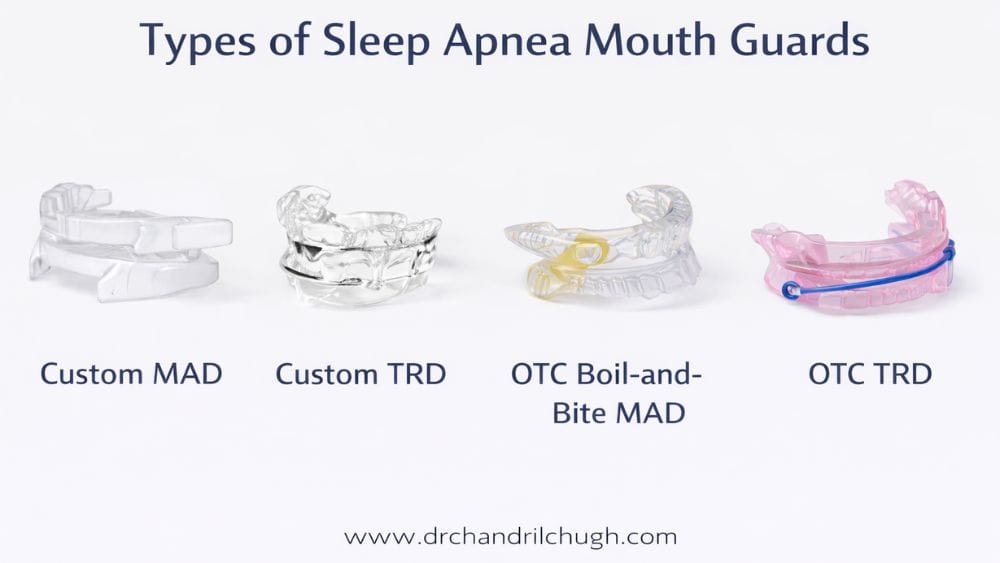
There are two main types of sleep apnea mouth guards, and choosing the right one depends on your anatomy, sleep apnea severity, and comfort preference.
Mandibular Advancement Devices (MADs)
MADs are the most widely prescribed type. They look like sports mouth guards but are designed specifically to hold your lower jaw in a forward position. They come in both custom-fitted and over-the-counter versions. Custom MADs allow millimeter-level adjustment, which is why dentists prefer them.
MADs reduce the AHI (Apnea-Hypopnea Index, which is the count of breathing interruptions per hour) by 50% or more in mild to moderate OSA.
Tongue Retaining Devices (TRDs)
TRDs are less commonly used. They work through suction rather than jaw repositioning. They are particularly useful for people with dentures or dental issues that make MADs uncomfortable. Some people find TRDs harder to tolerate initially.
Custom-Fitted vs Over-the-Counter Devices
Over-the-counter options are not a substitute for diagnosed sleep apnea treatment. They are acceptable for snoring or as a temporary option, but not for managing confirmed apnea.
| Device Type | Best For | Effectiveness | Comfort | Cost Range |
| Custom MAD | Mild to moderate OSA | High | High | $1,800 to $2,500 |
| Custom TRD | Dental issues, dentures | Moderate to High | Moderate | $500 to $1,500 |
| OTC Boil-and-Bite MAD | Snoring, very mild OSA | Low to Moderate | Low | $30 to $100 |
| OTC TRD | Tongue-based snoring | Low | Low | $20 to $80 |
Best Mouthpiece for Obstructive Sleep Apnea
The best mouthpiece for obstructive sleep apnea is one prescribed by a sleep specialist and fitted by a dentist who specializes in dental sleep medicine. Here is what makes a device actually effective.
Custom Dental Fitting
A dentist takes an impression of your teeth and bite. The device is then made to match your mouth exactly. This reduces sore spots, bite shifting, and device failure.
Adjustable Design
A good device lets you change how far forward the jaw is positioned. This is called titration. Starting with minimal advancement and slowly increasing it gives your jaw muscles time to adapt.
Material and Durability
Medical-grade acrylic or thermoplastic materials hold up well. A quality custom device lasts 3 to 5 years with proper care. Cheaper OTC options often warp within months.
Sleep Study Confirmation
Before any device is prescribed, a sleep study (polysomnography) should confirm your OSA severity. Wearing a device without a diagnosis is like taking blood pressure medication without ever checking your blood pressure.
Follow-Up Monitoring
After 1 to 3 months of use, a follow-up sleep study confirms the device is actually reducing your AHI. Without this check, you will not know if the treatment is working.
Benefits of a Sleep Apnea Mouthpiece
Improved Airflow and Reduced AHI
The core goal of any sleep apnea mouthpiece is to reduce apnea events. In people with mild to moderate OSA, oral appliances reduce the AHI significantly. Some patients reach normal levels (below 5 events per hour).
Reduced Snoring
Snoring happens when airflow vibrates loose tissue in your throat. By opening the airway, a sleep apnea mouthpiece cuts down on that vibration. Most users report a major drop in snoring within the first week.
Better Sleep Quality
Fewer apnea events mean fewer micro-awakenings. Your sleep cycles become deeper and more complete. REM sleep (the restorative stage) increases.
Daytime Energy Improvement
When your brain gets oxygen all night, you wake up feeling rested. Users often notice sharper focus and less daytime sleepiness within 2 to 4 weeks of consistent use.
CPAP Alternative for Selected Patients
CPAP (Continuous Positive Airway Pressure) is the gold standard for severe OSA. But many people cannot tolerate the mask, the noise, or the pressure. For those patients, a sleep apnea mouthpiece is a clinically accepted second choice, specifically for mild to moderate OSA.
Side Effects of Sleep Apnea Mouthpiece
The side effects of sleep apnea mouthpiece use are real but mostly temporary. Here is what to expect.
Jaw Pain
The most common complaint. Your jaw muscles are being held in an unfamiliar position for hours. This usually fades in 2 to 4 weeks as your muscles adapt.
Tooth Discomfort
Pressure on individual teeth can cause soreness, especially in the first month. If pain persists beyond 6 weeks, the device likely needs adjustment.
Dry Mouth or Excess Salivation
Some people produce more saliva when a foreign object is in the mouth. Others breathe through the mouth more and wake up with dryness. Staying well-hydrated helps.
Bite Changes Over Time
Long-term use of a sleep apnea mouthpiece can gradually shift tooth alignment. This is called dental occlusion change. Regular dental checkups catch this early. Jaw exercises in the morning help reduce the effect.
TMJ Stress
TMJ stands for temporomandibular joint, the hinge connecting your jaw to your skull. Holding the jaw forward adds stress to this joint. People with pre-existing TMJ disorders should consult a specialist before starting oral appliance therapy.
Short-term side effects (first 4 to 8 weeks): jaw soreness, increased saliva, mild tooth pressure, morning stiffness.
Long-term side effects (after 1 or more years): minor tooth movement, minor jaw joint changes. Both are manageable with monitoring.
Oral Appliance Therapy for Snoring and Apnea
Oral appliance therapy for snoring and apnea is formally recognized by the American Academy of Sleep Medicine (AASM) as a first-line treatment for mild to moderate OSA and for patients who fail CPAP.
The AASM recommends custom-fitted devices over OTC options. For mild OSA (AHI 5 to 15), oral appliances often perform as well as CPAP in reducing symptoms and improving quality of life. For moderate OSA (AHI 15 to 30), results vary but are still significant for many patients.
For severe OSA (AHI above 30), oral appliance therapy alone is usually not enough. It is sometimes combined with positional therapy or used when CPAP is entirely not tolerated.
Compared to CPAP, oral appliances have better compliance. People wear them more consistently because they are smaller, silent, and require no electricity or mask fitting.
How Long Does It Take to See Results?
Snoring reduction is often the first sign that things are working. Most people and their bed partners notice a difference within 1 to 2 weeks.
Apnea reduction takes a bit longer to confirm. You may feel more rested after 2 to 4 weeks of use, but the actual AHI reduction should be confirmed with a follow-up sleep study at 1 to 3 months.
A follow-up sleep study is not optional. It is the only way to verify the device is actually reducing your apnea events to safe levels.
Risks of Untreated Sleep Apnea
Skipping treatment for sleep apnea is not a neutral decision. Untreated OSA significantly raises the risk of serious health problems.
- Cardiovascular disease: Repeated drops in oxygen strain the heart and blood vessels overnight.
- Stroke: OSA increases stroke risk by up to 3 times due to irregular blood flow patterns during sleep.
- Hypertension (high blood pressure): Oxygen drops trigger adrenaline surges that raise blood pressure repeatedly throughout the night.
- Cognitive decline: Chronic sleep disruption impairs memory, focus, and long-term brain health.
- Daytime accidents: Excessive daytime sleepiness increases car accident risk significantly.
A sleep apnea mouthpiece is not just about sleeping better. It is about protecting your long-term health.
Frequently Asked Questions
Does a sleep apnea mouthpiece really work?
Yes. A sleep apnea mouthpiece reduces AHI by 50% or more in most people with mild to moderate OSA. Custom-fitted devices show the strongest results. A follow-up sleep study confirms effectiveness within 1 to 3 months of use.
Is a sleep apnea mouthpiece better than CPAP?
For mild to moderate OSA, outcomes are comparable. CPAP delivers higher AHI reduction, but sleep apnea mouthpiece devices have better compliance rates because more people actually wear them every night consistently.
Can I buy a sleep apnea mouthpiece over the counter?
Yes, but OTC devices are not recommended for diagnosed sleep apnea. A mouthpiece for mild sleep apnea treatment works best when custom-fitted based on a confirmed sleep study, not self-diagnosed snoring.
Is a sleep apnea mouthpiece safe long-term?
Yes, with annual dental monitoring. Long-term use of a sleep apnea mouthpiece can cause minor tooth movement or jaw joint changes. These are manageable when caught early through regular dental check-ups.
Does a sleep apnea mouthpiece cure sleep apnea?
No. A sleep apnea mouthpiece controls apnea while you wear it. It does not fix the underlying anatomy. If you stop using it, apnea events return.
How long does a sleep apnea mouthpiece last?
A custom-fitted sleep apnea mouthpiece typically lasts 3 to 5 years. OTC devices wear out within 6 to 12 months. Grinding teeth shortens the lifespan of any device.
Does a sleep apnea mouthpiece stop snoring completely?
For most people, yes. Oral appliance therapy for snoring and apnea eliminates or greatly reduces snoring in 85% to 90% of users, especially those whose snoring comes from throat tissue vibration.
Are there permanent side effects of a sleep apnea mouthpiece?
Rarely. The side effects of sleep apnea mouthpiece use are almost always reversible with proper monitoring. Permanent bite changes are uncommon and usually occur only after years of unsupervised use.
Who should not use a sleep apnea mouthpiece?
People with severe OSA, significant TMJ disorders, fewer than 8 healthy teeth for anchoring the device, or active gum disease. These cases require specialist review before considering types of sleep apnea mouth guards.
Is oral appliance therapy covered by insurance?
Most medical insurance plans, including Medicare, cover custom oral appliances when prescribed for diagnosed OSA. Dental insurance typically does not. Always verify coverage before ordering the best mouthpiece for obstructive sleep apnea.
About The Author

Medically reviewed by Dr. Chandril Chugh, MD, DM (Neurology)
Dr. Chandril Chugh is a U.S.-trained, board-certified neurologist with expertise in diagnosing and managing neurological disorders, including migraines, epilepsy, Parkinson’s disease, and movement disorders. His clinical focus includes evidence-based neurological care and patient education.
All content is reviewed for medical accuracy and aligned with current neurological guidelines.