Cognitive behavioral therapy for depression is a structured psychological treatment that changes how you think and act to reduce depressive symptoms. It works by identifying unhelpful thought patterns, correcting thinking errors, and replacing avoidance with healthier actions. This therapy does not rely on insight alone. It focuses on present-day problems, practical skills, and measurable progress. Cognitive behavioral therapy for depression improves mood, restores daily functioning, and lowers the risk of future depressive episodes.
Benefits Of Cognitive Behavioral Therapy For Depression
The benefits of cognitive behavioral therapy for depression extend beyond symptom relief. They include lasting changes in how your brain responds to stress and negative events.
Short-Term Symptom Reduction
C ognitive behavioral therapy for depression can reduce symptoms within several weeks when sessions are consistent. You may notice improved sleep, better concentration, and reduced emotional heaviness. These changes occur because CBT targets daily thinking habits that fuel sadness, guilt, and hopelessness.
Instead of accepting negative thoughts as facts, you learn how to test and correct them. This shift often reduces emotional intensity quickly.
Long-Term Relapse Prevention
One of the strongest advantages of cognitive behavioral therapy for depression is relapse prevention. Depression often returns because the same thinking patterns reappear under stress. CBT teaches you how to catch those patterns early. Long after therapy ends, you can still apply the same skills. People who complete cognitive behavioral therapy for depression often stay well longer compared to those who rely only on medication.
Skill-Building For Emotional Regulation
Depression disrupts emotional regulation, which means your emotions feel overwhelming or uncontrollable. Cognitive behavioral therapy for depression teaches practical regulation skills. You learn how to pause before reacting, separate emotions from actions, and respond with intention. These skills help during conflict, work stress, and personal loss. Over time, emotional reactions become less extreme and more manageable.
Improved Self-Awareness And Coping
Through guided reflection and structured monitoring, cognitive behavioral therapy for depression improves self-awareness. You begin to see patterns between situations, thoughts, and emotional reactions. This insight strengthens coping because you know what triggers your symptoms and how to respond. Instead of feeling helpless, you develop confidence in managing difficult moments.
Types Of CBT For Depression
There is no single version of CBT. Several validated approaches exist, each suited to different clinical needs. These are the most widely used types of CBT for depression in professional settings.
Traditional Cognitive Behavioral Therapy
Traditional CBT focuses on identifying distorted thoughts and correcting them using evidence-based questioning. Common distortions include all-or-nothing thinking, mental filtering, and excessive self-blame. In this approach, you learn how to challenge thoughts by examining facts rather than feelings. Traditional CBT remains the most researched and commonly used model among the types of CBT for depression .
Behavioral Activation Therapy
Behavioral activation addresses the behavioral side of depression. When you feel depressed, you tend to withdraw from activities that once gave pleasure or meaning. This withdrawal worsens mood.
Behavioral activation reverses this cycle by increasing activity before motivation improves. Behavioral activation alone can rival full CBT in effectiveness for many patients. It is one of the most practical types of CBT for depression for people with low energy or severe inactivity.
Cognitive Processing Therapy
Cognitive processing therapy is often used when depression follows trauma. Trauma can create rigid beliefs about safety, trust, guilt, or self-worth. These beliefs maintain both depression and emotional distress.
Cognitive processing therapy helps you examine and modify these beliefs in a structured way. This approach is particularly helpful when depressive symptoms are linked to past abuse or loss.
Acceptance-Based CBT Approaches
Acceptance-based approaches combine traditional CBT with acceptance skills. Instead of trying to eliminate every negative thought, you learn how to tolerate discomfort without avoidance. You act based on values rather than emotions. This approach helps when rumination and emotional avoidance dominate. Acceptance-based models remain an important part of modern types of CBT for depression .
CBT Techniques For Depression
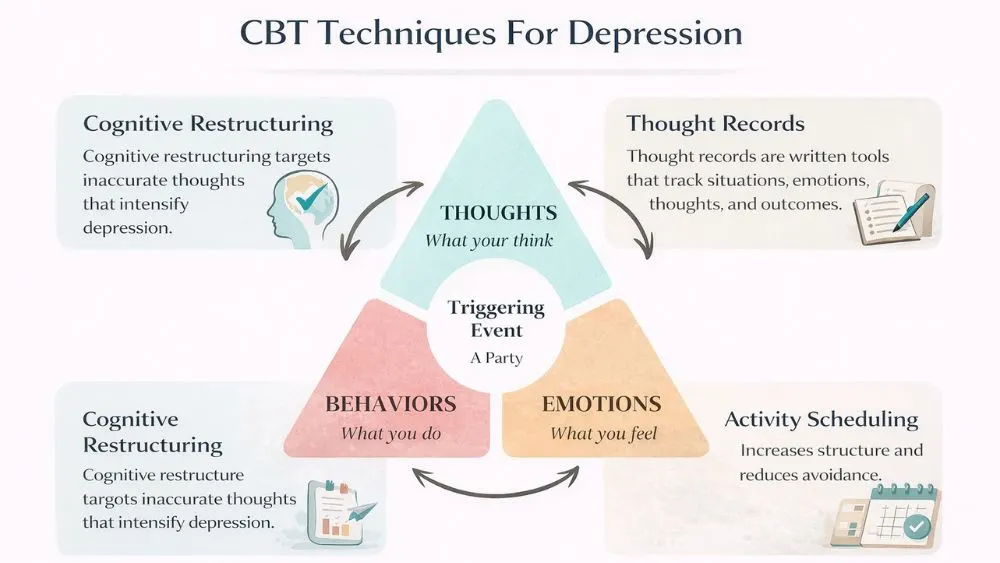
CBT works because it applies specific, repeatable tools. These CBT techniques for depression are selected based on symptom severity, thinking style, and daily functioning.
Cognitive Restructuring
Cognitive restructuring targets inaccurate thoughts that intensify depression. You identify automatic thoughts, examine supporting and opposing evidence, and form more balanced conclusions. This process weakens emotional reactions tied to false beliefs. Cognitive restructuring remains one of the most central CBT techniques for depression used in therapy.
Thought Records
Thought records are written tools that track situations, emotions, thoughts, and outcomes. Writing slows down thinking and makes patterns visible. Over time, you recognize recurring errors such as catastrophizing or mind-reading. Thought records strengthen insight and reinforce cognitive restructuring, which is why they are widely used among CBT techniques for depression .
Behavioral Experiments
Behavioral experiments test beliefs through real-life action. You predict what will happen if you act differently, then compare the outcome with your expectation. This method produces strong learning because it relies on experience rather than debate. Behavioral experiments are especially useful when beliefs feel emotionally convincing but lack evidence.
Activity Scheduling
Activity scheduling increases structure and reduces avoidance. You plan specific tasks and monitor mood before and after completion. This technique helps restore routine and purpose. Activity scheduling is a core part of behavioral activation and remains one of the most effective CBT techniques for depression for improving daily functioning.
CBT Exercises For Depression
CBT exercises work because they move therapy beyond conversation and into daily life. When you apply skills outside sessions, your brain starts forming new response patterns. These exercises are not motivational tricks. They are structured tasks designed to weaken depressive thinking and avoidance. Used consistently, CBT exercises for depression improve emotional stability and daily functioning.
Daily Mood Tracking
Daily mood tracking helps you notice patterns that are easy to miss in memory. You rate mood at set times and link changes to sleep, activity, and stress. Over time, you see which behaviors improve mood and which worsen it. This data-driven awareness reduces confusion and helps guide treatment decisions.
Automatic Thought Journaling
Automatic thought journaling captures thoughts that appear during emotional shifts. These thoughts often sound factual but reflect distorted thinking. Writing them down creates distance between you and the thought. Once visible, these thoughts become easier to question and correct using CBT skills.
Challenging Negative Core Beliefs
Core beliefs are deep assumptions about yourself, such as feeling unworthy or helpless. This exercise tests those beliefs using real evidence from your life. You list situations that contradict the belief and examine its origins. Repeated challenges weaken beliefs that silently maintain depression.
Exposure To Avoided Activities
Depression encourages avoidance, which increases isolation and low mood. Exposure reverses this cycle by gradually reintroducing avoided tasks. You start with manageable activities and increase difficulty over time. This process restores confidence and reduces emotional sensitivity to stress.
Gratitude And Evidence-Based Reframing
This exercise does not focus on forced positivity. You identify neutral or positive facts that counter negative thinking. Over time, your brain becomes better at balanced evaluation instead of emotional bias. This skill supports long-term recovery.
CBT Treatment For Depression
CBT treatment follows a predictable structure because consistency improves outcomes. A clear framework reduces uncertainty and builds trust in the process. CBT treatment for depression emphasizes collaboration, transparency, and measurable goals rather than passive discussion.
Session Structure And Frequency
Sessions typically last forty-five to sixty minutes and occur weekly. Each session reviews mood changes, applies specific techniques, and sets homework. The structure keeps sessions focused and prevents avoidance of difficult topics that maintain depression.
Duration Of CBT Treatment
Most people complete CBT treatment for depression in twelve to twenty sessions. Shorter courses may work for mild depression. Chronic or recurrent depression often requires extended treatment. Duration depends on symptom severity, consistency of practice, and coexisting mental health conditions.
Homework And Between-Session Practice
Homework is essential, not optional. Skills improve through repetition, not insight alone. Tasks may include thought records, activity scheduling, or behavioral experiments. Consistent practice predicts better outcomes than session attendance alone.
Measuring Progress In Therapy
Progress is tracked using symptom scales, behavioral changes, and functional improvement. Therapists adjust techniques based on this data. This measurement-based approach reduces guesswork and improves long-term results.
Risks Of CBT For Depression
CBT is generally safe, but it is not risk-free. Understanding the risks of CBT for depression helps set realistic expectations and improve engagement.
Emotional Discomfort During Sessions
Challenging negative beliefs can cause temporary distress. Emotions may intensify before they improve. This discomfort usually decreases as skills strengthen and confidence grows.
Limitations For Severe Or Psychotic Depression
CBT alone may not be sufficient for severe depression with psychotic symptoms. In such cases, distorted thinking may be too intense for cognitive techniques to work effectively without medication support.
When CBT Alone May Not Be Sufficient
CBT may not fully address depression linked to substance use, brain injury, or severe trauma without additional treatments. Combined approaches often produce better outcomes in complex cases.
Importance Of Therapist Competence
Poorly delivered CBT reduces effectiveness. Proper training ensures techniques are applied correctly and adapted to individual needs. Therapist skill strongly influences outcomes.
CBT Vs Medication For Depression
Treatment decisions depend on symptom severity, personal preference, and medical history. CBT treatment for depression and medication address depression through different mechanisms.
Effectiveness Comparison
For mild to moderate depression, CBT matches antidepressants in symptom reduction. CBT shows lower relapse rates after treatment ends because skills remain active.
CBT Combined With Antidepressants
Combined treatment produces stronger results for severe or recurrent depression. Medication stabilizes mood, while CBT addresses thinking and behavior patterns that drive relapse.
Who Benefits Most From CBT Alone
People with good insight, stable routines, and motivation often respond well to CBT without medication. Preference for structured problem-solving also predicts better outcomes.
When To Seek Professional Help For Depression
Self-guided strategies have limits. Professional evaluation ensures safety and accurate diagnosis. Cognitive behavioral therapy for depression works best when guided by trained clinicians.
Signs CBT Alone Is Not Enough
Worsening symptoms, inability to function, or persistent hopelessness suggest the need for additional support. These signs indicate a higher risk.
Red Flags Requiring Urgent Care
Suicidal thoughts, hallucinations, or severe agitation require immediate professional care. CBT should not delay crisis intervention.
Role Of Psychiatrists And Psychologists
Psychologists provide CBT. Psychiatrists manage medication and medical causes of depression. Collaboration improves treatment safety and effectiveness.
FAQs
Is Cognitive Behavioral Therapy Effective For Depression?
Yes. Cognitive behavioral therapy for depression consistently reduces symptoms by correcting distorted thinking and avoidance behaviors, with effects lasting beyond treatment when skills are practiced regularly.
How Long Does CBT Take To Work For Depression?
CBT typically shows measurable improvement within four to six weeks, with continued gains across twelve to twenty sessions when homework is completed consistently.
Can CBT Cure Depression Permanently?
No. Cognitive behavioral therapy for depression does not eliminate vulnerability, but it significantly reduces relapse by teaching skills that interrupt future depressive cycles.
Is CBT Effective For Severe Depression?
Yes, but rarely alone. Cognitive behavioral therapy for depression works best for severe cases when combined with antidepressants and close clinical monitoring.
What Happens In A CBT Session For Depression?
You review mood data, analyze specific thoughts or behaviors, practice CBT techniques, and plan homework that targets real-life situations, maintaining depression.
Can CBT Be Done Online For Depression?
Yes. Structured online CBT programs show strong results when they include guided sessions, homework feedback, and consistent scheduling.
Are CBT Exercises Effective Without A Therapist?
Partially. CBT exercises for depression can reduce mild symptoms, but therapist guidance improves accuracy, adherence, and long-term effectiveness.
What Are The Risks Of CBT For Depression?
The main risks of CBT for depression include temporary emotional discomfort and limited effectiveness in severe or psychotic depression without combined treatment.
How Does CBT Compare To Antidepressant Medication?
CBT matches medication for many cases and offers better relapse prevention because skills remain active after treatment ends.
Who Should Not Use CBT For Depression?
People in acute crisis, with psychosis, or severe cognitive impairment should not rely on CBT alone and need immediate medical care.
About The Author

Medically reviewed by Dr. Chandril Chugh, MD, DM (Neurology)
Dr. Chandril Chugh is a U.S.-trained, board-certified neurologist with expertise in diagnosing and managing neurological disorders, including migraines, epilepsy, Parkinson’s disease, and movement disorders. His clinical focus includes evidence-based neurological care and patient education.
All content is reviewed for medical accuracy and aligned with current neurological guidelines.