Lumbar lordosis is the natural inward curve in the lower back that helps your body stand upright, balance weight, and move without excessive strain. When this curve becomes too deep or too flat, it often develops for reasons such as weak core muscles, tight hip flexors, obesity, long hours of sitting, or structural spine problems. These changes can lead to symptoms like lower back pain, stiffness, muscle fatigue, difficulty standing straight, or pain that spreads into the hips and legs.
Doctors identify abnormal curvature by checking posture, taking X-rays or MRI scans, and reviewing how the spine, nerves, and muscles are working together. Treatment depends on the cause and may include physical therapy, stretching, weight control, posture training, pain relief methods, bracing in certain cases, or surgery for severe structural issues.
What Is Lumbar Lordosis?
Lumbar lordosis is the natural inward curve in your lower back, just above your buttocks. A small curve here is normal and helps you stand upright, walk, and absorb shock when you move. This curve is a healthy part of the spine shape, as long as it stays within a normal range.
When the curve becomes too deep or almost flat, the balance of your body changes. Over time, this can lead to pain, stiffness, and other lumbar spine curvature issues . The goal is not to “remove” lumbar lordosis but to keep it in a range that lets your spine work well.
How The Lumbar Spine Curves Naturally
Your spine is made of small bones called vertebrae (spinal bones) stacked on each other. In the lower back, these bones form a C-shaped inward curve. That curve is what doctors call lumbar lordosis .
Studies in adults show that the angle of this curve often falls roughly between 20 and 45 degrees, but the exact “normal” angle can vary between healthy people. Measuring the curve is tricky, and there is still some debate about which angle is best to use. So, doctors look at both the X-ray and how you feel, not only at numbers.
Role Of Lumbar Lordosis In Posture, Walking, And Spinal Load
When lumbar lordosis is located in a healthy range, your ears, shoulders, and hips line up more easily. This means your muscles do not need to work as hard to keep you standing. The curve acts like a spring that spreads force when you walk, climb stairs, or lift objects.
If the curve is too deep, joints at the back of the spine carry more load. If the curve is too flat, discs and ligaments may take more stress. In both cases, the risk of long-term lumbar spine curvature issues and low back pain can rise, although research shows that curve angle alone does not always predict who will feel pain.
Difference Between Cervical, Thoracic, And Lumbar Curves
Your spine has three main curves when seen from the side.
The neck curve, called cervical lordosis, bends inward. The mid-back curve, called thoracic kyphosis, bends outward. The lower back curve, lumbar lordosis , bends inward again. Together they form an S-shape that helps you balance and move with less effort.
If lumbar lordosis changes, the other curves often shift too. For example, a very deep lower back curve can make your upper back round more to keep your eyes level. This chain effect explains why poor lower back alignment can trigger neck or upper back discomfort, not only local pain in the waist area.
Causes Of Lumbar Lordosis
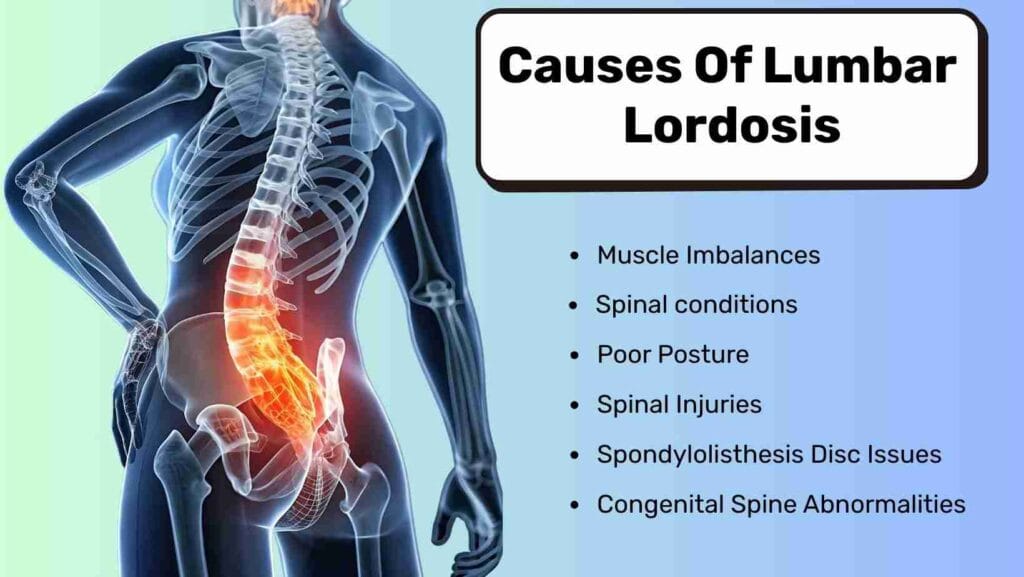
There is no single cause for every person. Many cases develop slowly, from posture and muscle habits, while others come from bone or joint disease. Large reviews show that extra body weight, weak muscles, and high physical load all link with low back problems in general, although the exact causes of lumbar lordosis vary between people.
Muscle Imbalances (Weak Core, Tight Hip Flexors)
Your core muscles in the front and sides of the trunk help hold your ribs and pelvis (hip bone area) steady. Your hip flexors, at the front of your hips, help lift the thigh.
When core muscles stay weak, and hip flexors stay tight, your pelvis tends to tilt forward. This tilt deepens lumbar lordosis and makes the lower back muscles work harder all day. Over time, this pattern can cause aching, stiffness, and a sense of tired back muscles, even with light tasks.
Obesity And Abdominal Mass Pulling The Spine Forward
Extra fat around the belly shifts your center of mass forward. To keep you from falling, your spine often increases lumbar lordosis so that your upper body stays over your feet.
Studies link obesity with greater low back pain and show that people with obesity may have increased lower back curve and reduced spine mobility. This does not mean every person with obesity will have back pain, but it helps explain why weight control is a key part of managing lumbar lordosis problems.
Poor Posture And Prolonged Sitting
Long hours of sitting at school, at work, or on screens can change your posture. If you sit with your lower back pushed forward and chest leaning back, the lower curve can become too deep. If you slump with your tail tucked under, the curve can flatten.
WHO and major back pain guidelines highlight long static postures and poor ergonomics as important risk factors for back pain in general, even though exact links with lumbar lordosis angle are still being studied.
Spinal Injuries Or Degenerative Changes
Injuries from falls, sports, or accidents can change how vertebrae and discs line up. Fractures, joint damage, or disc problems may tilt parts of the spine and change lumbar lordosis .
With age, discs lose water and height, and joints can develop arthritis. These changes may lead either to extra curve or to a flatter lower back, depending on which structures wear most. Evidence here is mixed and still growing, so doctors often judge each case individually and may rely on both scan results and your symptom history.
Congenital Spine Abnormalities
Some people are born with spine bones that are shaped differently, or with fewer or more vertebrae than usual. Conditions such as caudal regression syndrome can include abnormal curves like lordosis.
In these cases, lumbar lordosis can look unusual from early childhood. Doctors usually monitor growth, because some children do well with only observation and exercise, while others may need bracing or surgery later. Research in rare congenital problems is limited, so treatment often follows expert opinion and careful follow-up rather than large trials.
Spondylolisthesis And Disc Issues
Spondylolisthesis means one vertebra slips forward over the one below it. This often happens in the lower back and can increase lumbar lordosis as the body tries to keep balance.
Bulging or herniated discs can also affect posture. When a disc presses on a nerve, you may lean or twist to avoid pain. If this becomes a long-term habit, the shape of lumbar lordosis may change, which can add to your lumbar spine curvature issues over time.
Normal Vs Abnormal Lumbar Lordosis
Doctors talk about normal vs abnormal lumbar lordosis rather than “good” or “bad” backs. A normal curve supports your body with little pain. An abnormal curve is either too deep or too flat and often shows up with symptoms or visible imbalance.
What Is Considered A Normal Lordotic Curve?
Most adults have a lumbar lordosis angle somewhere around 20 to 45 degrees when measured between the top of the first lumbar vertebra and the sacrum, but different studies give slightly different ranges.
Because of this, doctors do not rely only on one angle. They look at your posture, how you move, and whether you have pain, numbness, or weakness. Research clearly shows that some people with large curves feel fine, while some with smaller curves have pain, so the whole clinical picture matters.
Hyperlordosis (Excessive Lumbar Curve)
Hyperlordosis means the lower back curve is deeper than expected. The pelvis tilts forward, the buttocks may stick out more, and the belly may look more prominent.
This shape can increase pressure on facet joints (small joints at the back of the spine) and tighten the lower back muscles. Some people have no pain, but others develop ongoing low back pain or leg symptoms, especially if other problems like weak core or obesity are present.
Loss Of Lordosis / Flat Back Syndrome
Loss of lumbar lordosis is often called flat back. The lower spine looks straight instead of gently curved. People with flat back may feel like they lean forward and must bend their hips or knees to stand upright.
Flat back can follow certain spine surgeries, fractures, or long-term degeneration. It can cause fatigue, stiffness, and pain when you stand or walk for longer periods.
How Posture, Age, And Weight Affect Spinal Curvature
Your posture habits, your age, and your body weight all shape lumbar lordosis . Poor posture at work or school, long screen time, and little movement can slowly shift the curve.
Age and body weight add more load to the lower back. Studies link higher body mass index with changed lumbosacral angles and greater low back pain risk, but they also note that not every person with obesity develops strong pain.
When Changes In Curvature Become Problematic
A curve becomes a problem when it causes pain, stiffness, balance issues, or nerve symptoms. If your clothes hang crooked, if one hip looks higher, or if standing straight feels hard, your lumbar lordosis may have shifted outside a comfortable range.
At that stage, doctors look at normal vs abnormal lumbar lordosis for you as an individual, not only the textbook angle. Early review helps prevent small shape changes from growing into long-term disability.
Lumbar Lordosis Symptoms
You can have lumbar lordosis that looks unusual on X-ray and still feel fine. Symptoms appear when the curve and the surrounding muscles, joints, and nerves stop working well together. When doctors speak about lumbar lordosis symptoms , they think about both pain and how your body works in daily life.
Lower Back Pain And Stiffness
The most common complaint is a dull ache or tightness in the lower back that worsens after standing or sitting for long periods. These lumbar lordosis symptoms usually come from overworked muscles and joints that carry more load than they should.
Difficulty Standing Straight Or Walking Normally
You might feel that you tilt forward or backward when you try to stand tall. Long walks or standing in a queue can bring on pain or strong fatigue. This often happens when lumbar lordosis is very deep or almost flat, so your body must work harder to keep balance.
Muscle Spasms And Fatigue
When back muscles work too hard, they can suddenly tighten into a painful spasm. You may feel a sharp “knot” that stops you for a moment. Long-term overuse around lumbar lordosis also leads to deep tiredness in the back, even after light tasks.
Radiating Pain To Hips, Buttocks, Or Legs
If joints or discs in the lower spine press on nearby nerves, pain can spread from the back into the buttocks, hips, or legs. Sometimes this follows the sciatic nerve. These lumbar lordosis symptoms suggest nerve involvement and need medical review.
Postural Imbalance And Pelvic Tilt
A very forward-tilted pelvis can make your lower back look overly arched. A backward-tilted pelvis can make it look flat. Both patterns change how lumbar lordosis lines up with the rest of the spine and can lead to uneven strain on hips and knees.
Symptoms In Children Vs Adults
Children with increased lumbar lordosis often show more visible curve and may complain of tiredness rather than sharp pain. In adults, pain, stiffness, and limitations in daily tasks are more common. Large children’s hospitals note that most mild curves in kids stay harmless, but any curve that grows fast or causes pain should be checked.
Diagnosis: How Doctors Evaluate Lumbar Curvature
Physical Examination & Posture Analysis
When a doctor checks lumbar lordosis , the first step is a clear talk with you. You explain your pain, daily habits, work type, and any injuries or health conditions. Then the doctor watches how you stand, walk, bend, and sit.
You are viewed from the side, front, and back. The doctor checks whether your head, shoulders, and hips line up, or if your pelvis tilts forward or backward. They feel along the spine for tender spots and tight muscles and check leg strength and reflexes. This helps link your visible posture with your lumbar lordosis symptoms .
X-Rays To Measure Spinal Curvature Degrees
Standard X-rays show the bones of your spine. The doctor can measure the angle of lumbar lordosis and see if one vertebra has slipped forward, if discs are losing height, or if there are bone spurs.
X-rays help compare normal vs abnormal lumbar lordosis in your case. Still, your pain level and function matter as much as the number on the report. Two people with the same angle can feel very different.
MRI For Disc, Nerve, And Soft-Tissue Evaluation
An MRI scan gives a detailed view of discs, nerves, and soft tissues. It can show disc bulges, herniations, inflammation, or spinal canal narrowing.
Your doctor usually orders MRI if you have numbness, tingling, weakness, or pain that runs into your legs. These signs suggest that lumbar spine curvature issues might be affecting nerves, not only muscles and joints.
When Diagnosis Indicates A More Serious Condition
Urgent problems are rare, but doctors stay alert. Warning signs include strong leg weakness, loss of control of bladder or bowel, or severe pain after trauma.
If scans show serious nerve pressure, infection, fracture, or tumor, lumbar lordosis is only part of a larger problem. In such cases, you may need fast care from a spine surgeon or another specialist.
Lumbar Lordosis Treatment
Lumbar lordosis treatment depends on your age, curve shape, symptoms, and overall health. No single plan fits everyone. The main goals are less pain, better posture, stronger muscles, and safer movement.
Physical Therapy: Core Strengthening & Posture Correction
A physical therapist teaches you how to move without overloading the lower back. You practice exercises that build your deep core muscles, your glutes, and the small muscles near the spine.
You also learn how to sit, stand, and lift without forcing extra lumbar lordosis . Small daily changes, such as how you get out of bed or how you bend to pick up objects, can reduce stress on the spine.
Stretching Tight Muscles (Hip Flexors, Back Extensors)
Tight hip flexors and tight back extensors pull your pelvis and spine out of balance. Your therapist gives you simple stretches you can repeat at home, often several times a day.
For example, gentle lunges for the front of the hip and knee-to-chest movements for the lower back can help. Over time, balanced flexibility supports healthier lumbar lordosis and reduces painful muscle tension.
Weight Management & Activity Modification
If you carry extra weight around your midsection, your lower back works harder to hold you upright. Reducing weight through a balanced diet and regular low-impact activity, such as walking or cycling, eases load on the spine.
Activity changes also matter. You may need to limit heavy lifting for a while, split long-standing tasks into shorter blocks, or change how you set up your work area. These steps support long-term lumbar lordosis treatment results.
Bracing (In Children Or Specific Cases)
In some children with strong curves or structural problems, a brace helps guide growth of the spine. The brace supports the trunk and can stop the curve from getting worse.
In adults, bracing has a smaller role. It may be used for short periods for certain lumbar spine curvature issues , such as after injury or surgery, to give temporary support while muscles recover.
Pain Management: NSAIDs & Heat/Ice Therapy
Doctors often start with simple pain relief measures. They may advise non-steroidal anti-inflammatory drugs if they are safe for you. Heat can relax tight muscles, while ice can help after acute strain.
These methods do not change lumbar lordosis itself. They help you stay active and able to join therapy, which is where the real long-term gains usually happen. Dosage and exact medicine choices always depend on your age, health, and other drugs you take.
Chiropractic & Manual Therapy
Some people notice short-term relief from chiropractic adjustments or other hands-on care, such as mobilization or soft tissue work. These methods aim to improve joint movement and ease muscle tension around lumbar lordosis .
This type of care should fit into a full plan that also includes exercise and posture changes. You should always tell your chiropractor or therapist about MRI or X-ray findings before treatment.
Surgical Treatment For Severe Structural Abnormalities
Surgery is reserved for cases where pain stays strong despite careful care, or where there is clear nerve damage or major deformity. Surgical options might include fusing certain vertebrae or adding hardware to correct alignment.
The goal is to restore a safer curve and protect nerves, not to build a “perfect” spine. Recovery includes rehab and often some of the same exercises used in non-surgical lumbar lordosis treatment .
Lumbar Spine Curvature Issues
Flat Back Syndrome (Loss Of Lordosis)
Flat back means the normal inward curve in the lower spine has nearly disappeared. You may feel like you lean forward and cannot stand fully upright for long.
This kind of lumbar spine curvature issues often brings strong fatigue and stiffness. Walking or standing for long periods can feel much harder than sitting.
Hyperlordosis From Pregnancy, Obesity, Or Weak Core
During pregnancy, the growing baby pulls your center of mass forward. Many people naturally increase lumbar lordosis to stay balanced. After birth, the curve often improves, but weak core muscles can keep it deeper than before.
With obesity and a weak core, a similar pattern happens. The belly pulls forward and the lower back curves more. This combination can feed lumbar lordosis symptoms such as aching, stiffness, and muscle fatigue.
Spine Curvature Changes Due To Aging
As you age, discs lose water, joints wear down, and muscles lose strength if you do not stay active. These changes can flatten or deepen the curve in your lower back.
Mild changes are expected with age. Problems start when these changes and lumbar spine curvature issues reduce your ability to walk, sleep, or do basic tasks without pain.
How Lumbar Curve Abnormalities Affect Mobility & Daily Life
Abnormal lumbar lordosis affects more than your X-ray. It shapes how you feel during real daily work. Tasks like cooking, cleaning, lifting children, or even brushing your teeth can become painful or tiring.
You may avoid movement to escape pain. That often leads to weaker muscles, more stiffness, and more pain, creating a difficult cycle. Breaking that cycle with treatment and smart habits is key.
Long-Term Complications If Untreated
If significant curve problems and lumbar lordosis symptoms stay untreated, the risk of disc herniation, nerve compression, and spinal stenosis (narrowing of the spinal canal) increases.
Long-term pain can also affect mood, sleep, and social life. In many people, early care slows or limits these complications and keeps function much higher over the years.
Prevention & Long-Term Spine Health
Lifestyle Habits That Protect Lumbar Curvature
You protect lumbar lordosis every day through simple choices. Walking regularly, keeping your weight in a healthy range, and avoiding smoking all support disc and joint health.
Staying active is usually safer than long-term rest. Strong, flexible muscles protect your spine better than any brace can.
Proper Ergonomics And Posture Tips
At a desk, keep your feet flat, hips and knees at similar heights, and your lower back supported. Your screen should sit at eye level, so your neck and lower back do not strain forward.
When you stand, distribute weight on both feet, keep your knees soft, and think of stacking your head over shoulders and hips. This line helps maintain comfortable lumbar lordosis without extra effort.
Exercises To Maintain Healthy Spine Alignment
Simple core exercises, such as gentle planks, bird-dog movements, and glute bridges, help you control your spine. Hip stretches and hamstring stretches reduce pulling on the pelvis.
It is safer to learn these with a therapist at first. Then you can continue on your own as part of your weekly routine. Regular practice is more important than hard workouts once in a while.
FAQ
Can Lumbar Lordosis Be Corrected?
Many cases of lumbar lordosis related to posture, weak muscles, or extra weight can improve with exercise, weight control, and education. Structural problems may not fully reverse, but symptoms and function often improve greatly.
Is Lumbar Lordosis Dangerous?
Normal lumbar lordosis is not dangerous, it is necessary. Problems arise when curve changes cause pain, stiffness, or nerve issues. Early review and treatment usually keep you far from serious complications.
What Is The Difference Between Lordosis And Scoliosis?
Lordosis refers to the inward curve seen in your neck and lower back, such as lumbar lordosis . Scoliosis is a side-to-side curve of the spine that looks like an S or C when viewed from behind.
Does Lordosis Cause Nerve Pain Or Sciatica?
Abnormal lumbar lordosis can contribute to nerve pain when discs or joints press on nearby nerves. This can lead to sciatica, with pain, numbness, or tingling running from the lower back into the leg.
How Long Does Treatment Take To Improve Lordosis?
Time varies by cause and severity. Some posture-related cases improve in weeks with steady work. More complex lumbar lordosis treatment plans may take months of therapy and lifestyle changes to show clear results.
When Should I See A Spine Specialist?
You should see a specialist if pain lasts longer than a few weeks, if symptoms get stronger, or if you notice leg weakness, numbness, or bladder or bowel changes linked with lumbar lordosis .
How Do Muscle Imbalances Contribute To Lumbar Lordosis?
Weak core and glute muscles and tight hip flexors tilt your pelvis forward and deepen lumbar lordosis . Correcting these imbalances with specific exercises often reduces pain and improves posture and spinal control.
Can Obesity Or Abdominal Weight Increase Lordosis?
Yes, extra belly weight pulls your trunk forward, which often increases lumbar lordosis . Weight loss combined with strengthening exercises can reduce stress on the lower spine and lower your risk of recurring pain.
How Does Poor Posture Or Prolonged Sitting Impact Lumbar Curvature?
Slouching or sitting in one rigid position for hours can slowly change muscle length and joint position. Over time, this may alter lumbar lordosis and raise your chance of discomfort or stiffness.
Can Spinal Injuries Or Degenerative Disc Changes Affect Lordosis?
Injuries and disc wear can change how vertebrae line up and how discs carry load. This can flatten or deepen lumbar lordosis , sometimes leading to pain, stiffness, and nerve-related symptoms in your legs.
What Congenital Conditions Can Lead To Lordosis Abnormalities?
Some people are born with wedge-shaped vertebrae or unusual bone structure that affect lumbar lordosis . Certain genetic bone conditions and spinal development problems in childhood can also lead to long-term curve changes.
About The Author

Medically reviewed by Dr. Chandril Chugh, MD, DM (Neurology)
Dr. Chandril Chugh is a U.S.-trained, board-certified neurologist with expertise in diagnosing and managing neurological disorders, including migraines, epilepsy, Parkinson’s disease, and movement disorders. His clinical focus includes evidence-based neurological care and patient education.
All content is reviewed for medical accuracy and aligned with current neurological guidelines.